Servo Motor Working Principle: How a Servo Works and What Is Inside
A servo motor is a closed-loop actuator that combines a small DC motor, a gear reduction train, a position sensor (potentiometer or magnetic encoder), and a control circuit that continuously compares the commanded position with the actual position and adjusts the motor until they match. The standard hobby servo receives a PWM signal every 20 ms — a 1 ms pulse commands 0°, a 1.5 ms pulse commands 90°, and a 2 ms pulse commands 180°. Inside, the control board drives the motor forward or backward until the sensor reads the commanded angle, then holds it with torque. This feedback loop is what makes a servo a “servo” rather than just a motor.
- Input: a PWM pulse (1-2 ms width) tells the servo where to go — 1 ms = 0°, 1.5 ms = 90°, 2 ms = 180°.
- Compare: the control board compares the commanded angle with the current angle from the position sensor.
- Drive: the motor spins the gear train toward the target; the gear train multiplies torque.
- Hold: once the sensor matches the command, the servo holds position with torque — that is the feedback loop.
Anatomy of a Servo: The 4 Core Components
Every servo — from a 9 g micro servo to a 70 kg·cm heavy-duty unit — contains the same four building blocks:
| Component | What it does | Why it matters |
|---|---|---|
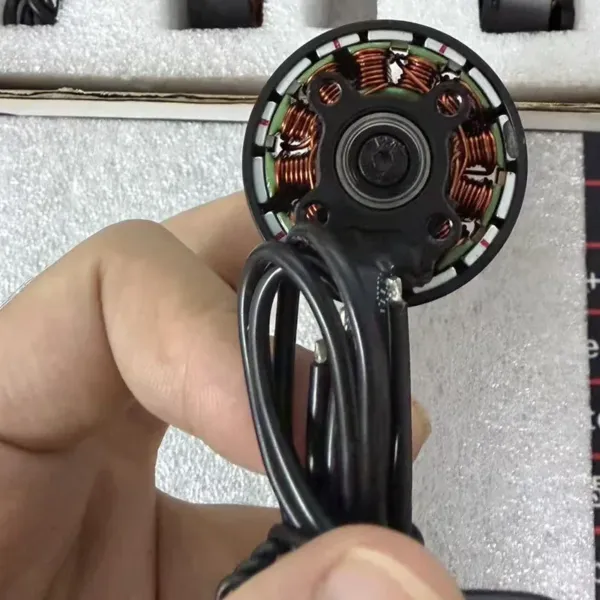
| DC motor | Spins at high speed when driven | Type (brushed / coreless / brushless) decides speed, life and cost |
| Gear train | Reduces motor speed, multiplies torque | Gear material (nylon / metal / steel) decides durability |
| Position sensor | Reads the output shaft angle | Potentiometer (analog) or magnetic encoder (digital, no wear) |
| Control board | Compares command vs position, drives motor | Digital boards give faster, more precise response than analog |
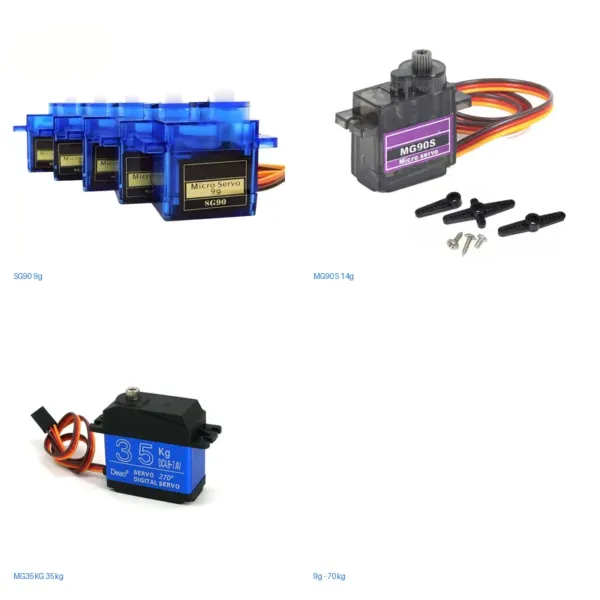
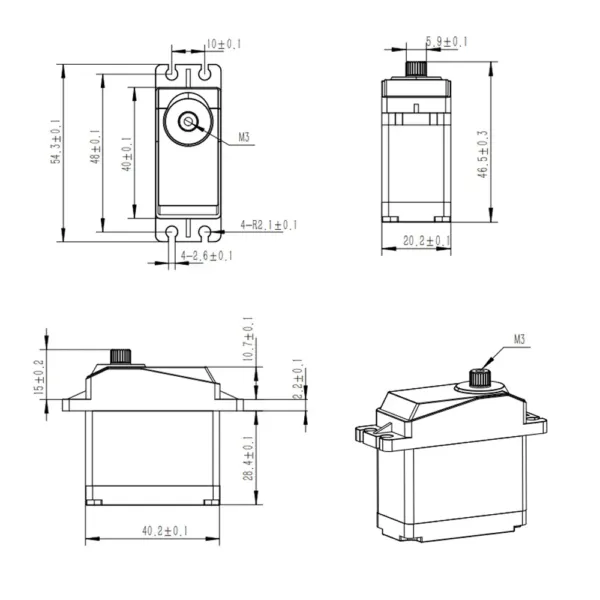
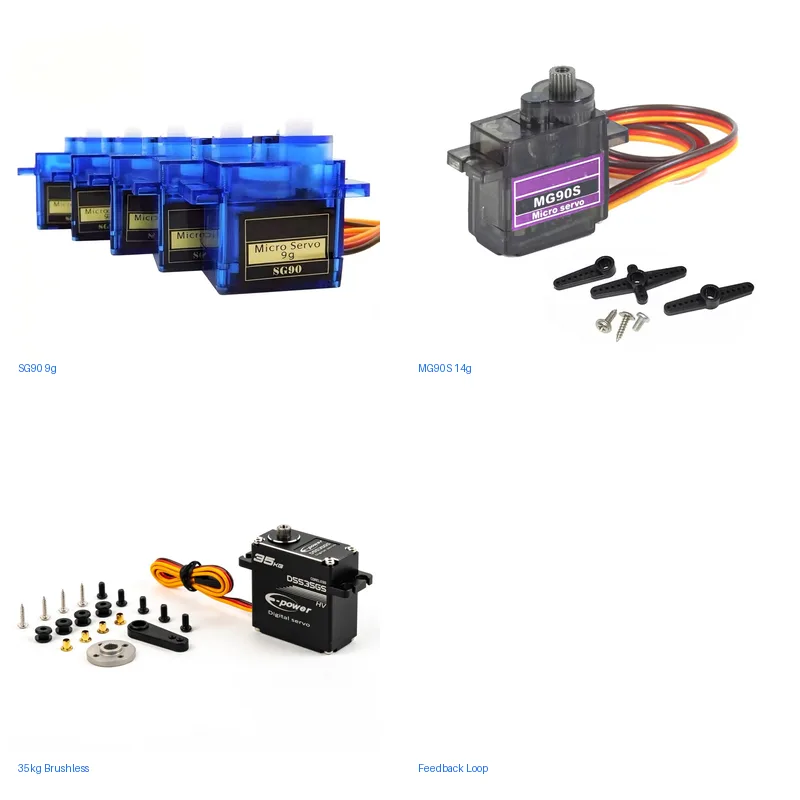
In a 9 g micro servo like the SG90, these parts are packed into a 22.8 x 12.2 x 28.5 mm body with nylon gears. In a heavy-duty unit like the MG35KG 35 kg, the same architecture uses a full steel gear train and a digital control board to handle continuous high load.
The Feedback Loop: 5 Steps Inside Every Servo Cycle
The working principle is a continuous closed-loop cycle. Here is exactly what happens, step by step:
- The command arrives: the receiver or flight controller sends a PWM pulse. A 1.5 ms pulse means “go to center (90°)”.
- The sensor reports: the potentiometer (or magnetic encoder) reads the current shaft position as a voltage.
- The board compares: the control circuit subtracts the actual position from the commanded position. The difference is the error.
- The motor drives: if there is an error, the board powers the motor through the gear train to reduce it — one direction for “too low”, the other for “too high”.
- Hold and correct: when the sensor matches the command, the motor stops, but the servo keeps applying torque to hold position against external load — and re-corrects instantly if disturbed.
This loop runs hundreds of times per second. The faster the loop and the more sensitive the sensor, the sharper and more precise the servo feels — which is exactly the difference between analog and digital servos.
Analog vs Digital Servo: The Same Principle, Different Loop Speed
Both analog and digital servos use the same closed-loop principle, but they update the loop at different rates:
| Feature | Analog servo | Digital servo |
|---|---|---|
| Update rate | ~50 Hz (every 20 ms) | 300-500 Hz (every 2-3 ms) |
| Response | Slightly delayed feel | Instant, sharper feel |
| Holding torque | Weaker under disturbance | Stronger, more consistent |
| Current draw | Lower | Higher (more pulses per second) |
| Typical use | Planes, light models, budget builds | Cars, crawlers, robot arms, precise controls |
The SG90 and MG90S micro servos are analog; the MG20KG-35KG, HB and D series in our range are all digital. If you are choosing, digital gives noticeably better holding and response for steering and robotics — see our micro servo guide for the size trade-offs.
Three Motor Types Inside Servos: Brushed, Coreless and Brushless
The motor at the heart of the servo is the biggest technical differentiator. All three types use the same feedback loop, but the motor behaves differently:
| Motor type | How it works | Best for | Yadovex example |
|---|---|---|---|
| Brushed | Physical brushes switch current; simple, cheap | Budget and micro builds | SG90, MG90S, MG series |
| Coreless | No iron armature core — lower inertia, faster response | Speed-critical controls, high-performance RC | D5535GS 35 kg, D5555GS 55 kg |
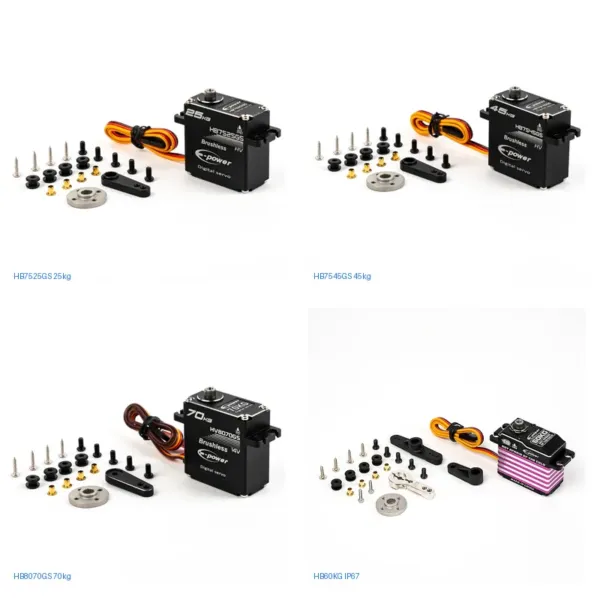
| Brushless | Electronic commutation — no wear parts, longest life | Continuous heavy duty, waterproof builds | HB7525GS-HB8070GS 25-70 kg |
The D-series coreless servos pair the low-inertia motor with a magnetic encoder — the D5555GS reaches 58 kg·cm at 8.4V with 0.08 s/60° speed, which is why coreless is the choice for response-critical racing and robot applications. The HB brushless series trades some peak speed for lifespan and waterproof sealing. Both are covered in our brushless servo explainer.
How to Read a Servo Spec Sheet (and What It Means Physically)
Once you understand the working principle, spec sheets make sense:
- Torque (kg·cm): the holding force the gear train can sustain at 1 cm from the shaft — 35 kg·cm means it holds 35 kg at 1 cm. More gears = more torque, slower speed.
- Speed (s/60°): how long the output shaft takes to sweep 60°. The D5535GS does 0.07 s/60° at 7.4V — very fast.
- Voltage range: higher voltage = more torque and speed, up to the board’s limit. A servo rated 6-8.4V delivers its best at 8.4V.
- Sensor type: magnetic encoder (digital) has no wear parts; a potentiometer can wear over very long use.
These numbers all trace back to the same loop: bigger motor and gear reduction for torque, faster motor and lower gear ratio for speed, better sensor and digital board for precision.
FAQ
How does a servo motor work?
A servo works as a closed-loop system: a PWM signal commands a target angle, a position sensor reads the current angle, a control board compares the two and drives the motor through a gear train until they match, then holds position with torque.
What does PWM mean for servos?
PWM (pulse-width modulation) is the control signal. The width of a 1-2 ms pulse, repeated every 20 ms, commands the angle: 1 ms = 0°, 1.5 ms = 90° (center), 2 ms = 180°.
What is the difference between analog and digital servos?
Both use the same feedback loop, but digital servos update it at 300-500 Hz versus ~50 Hz for analog. Digital gives faster response, stronger holding torque and sharper feel, at the cost of higher current draw.
What are the parts of a servo motor?
A servo has four core parts: a DC motor (brushed, coreless or brushless), a gear reduction train, a position sensor (potentiometer or magnetic encoder), and a control board that runs the feedback loop.
What is a coreless servo motor?
A coreless servo uses a motor with no iron armature core, which reduces inertia and improves acceleration and response speed. Coreless servos like the D5535GS and D5555GS are ideal for speed-critical controls.
Do servos use a lot of power?
Servos draw current only when moving or holding under load. Digital servos draw more than analog because they update the loop faster; a 35 kg·cm servo under heavy load can draw several amps in peaks. Match your BEC or ESC rating accordingly.
Final Verdict
Understanding the working principle makes choosing easy: match the motor type to the duty (brushed for budget micro builds, coreless for response-critical controls, brushless for continuous heavy duty), the gear material to the load (nylon for light, steel for heavy), and the board to the precision you need (analog for planes, digital for cars and robots). For a fast coreless option, the D5535GS 35 kg is a proven pick; for a waterproof heavy-duty workhorse, the HB7535GS 35 kg brushless runs nearly forever.
Want to see the full servo range and compare specs? Browse our servo collection — 26 models from 9 g micro to 70 kg·cm, covering analog, digital, coreless and brushless. Contact Yadovex if you need help matching a servo to your project, or custom OEM/ODM builds.

Hallen Liu is a product and sourcing specialist at Yadovex, a China-based supplier of FPV and UAV brushless motors, servos and propellers. He works directly with drone builders, distributors and OEM buyers on motor selection, thrust-test data, custom KV and OEM/ODM orders — from sample validation through repeat bulk shipments.