Outrunner vs Inrunner Brushless Motors: Which One Should You Choose?
An outrunner brushless motor spins its outer can (bell) around a stationary stator, while an inrunner spins a shaft inside the can. For FPV drones, multirotors and most aircraft, outrunners are the right choice: they deliver more torque per gram at low RPM, which is exactly what spinning a propeller needs. Inrunners belong in high-RPM, low-torque applications such as EDF fans, RC car motors and some gimbal motors.
Quick Answer: Outrunner vs Inrunner
- Outrunner: outer bell rotates, high torque at low RPM, lower kV range (typically 300–2,400 kV), best for propellers and multirotors.
- Inrunner: inner shaft rotates, high RPM and low torque, higher kV range (often 2,000–10,000+ kV), best for EDFs, cars and high-speed applications.
- Same core physics: 3-phase brushless design with ESC-driven commutation; the difference is where the rotor sits.
- For a drone motor, choose outrunner; for a ducted fan or car, choose inrunner.
What Is an Outrunner Brushless Motor?
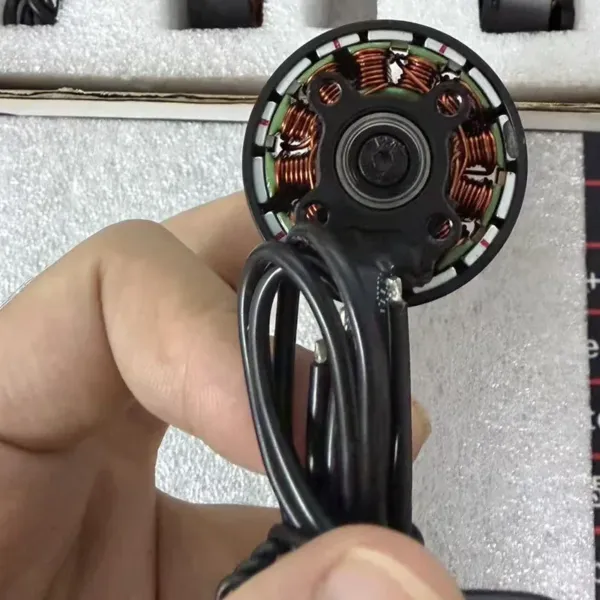
An outrunner motor has the rotor (permanent magnets) mounted on the outer bell, which rotates around the fixed stator and windings. The output shaft is attached to this bell, so the shaft spins at the same speed as the bell. This layout gives a large rotor diameter relative to the stator, which is why outrunners generate high torque at moderate RPM without heavy reduction gearing.
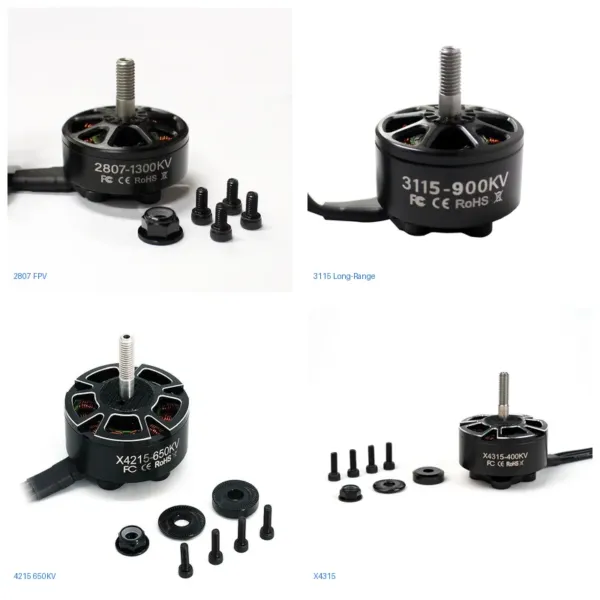
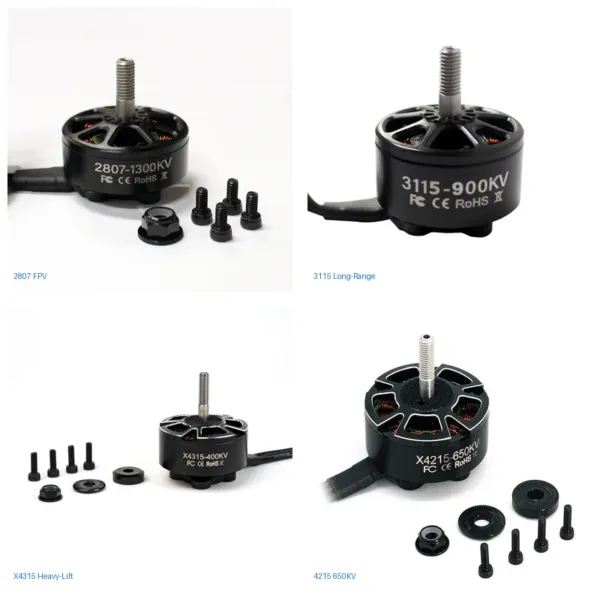
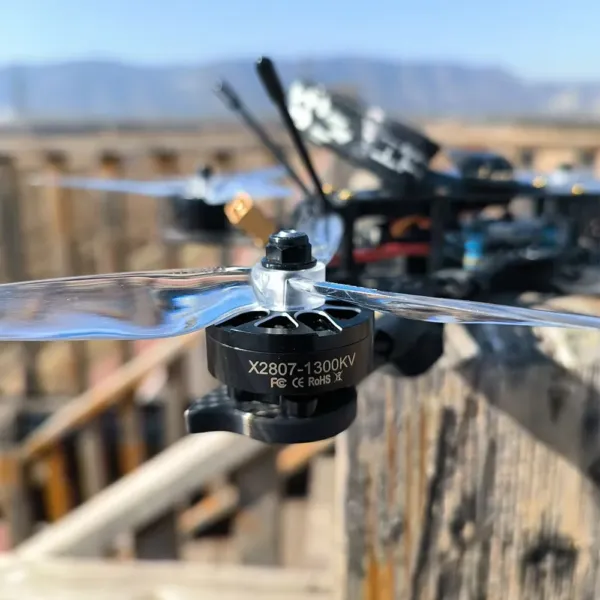
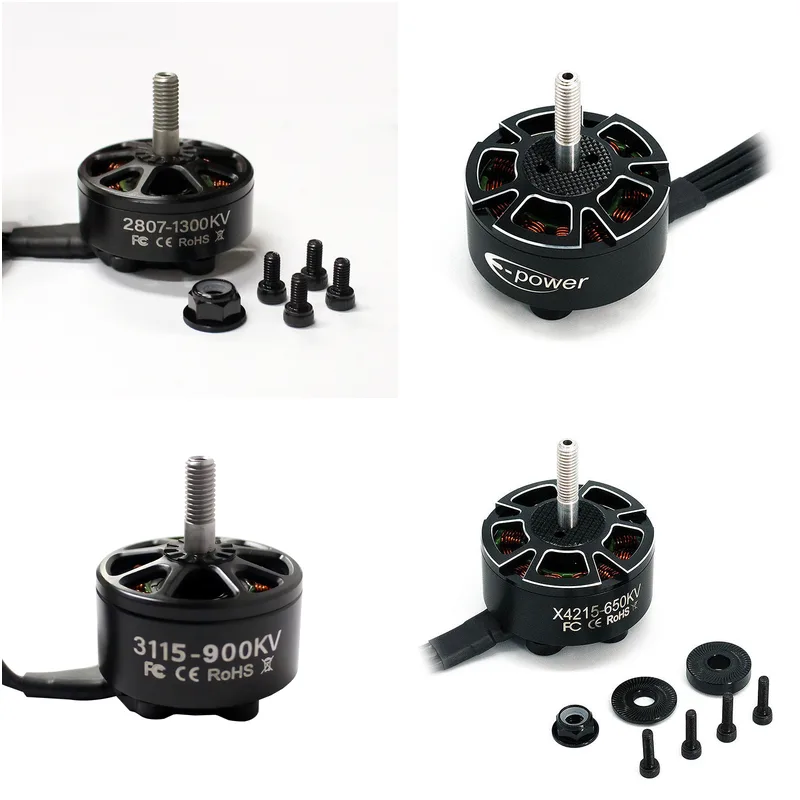
In FPV and multirotor terms, an outrunner is what you see on every arm of a drone: a compact motor such as the 2807-1300KV or the heavier X4215-400KV that spins a propeller directly. The 28 mm or 42 mm bell diameter directly sets the torque class of the motor.
What Is an Inrunner Brushless Motor?
An inrunner motor has the rotor and permanent magnets inside the stator, so only the shaft protrudes and rotates. Because the rotor is small and light, an inrunner can spin at very high RPM; torque, however, is limited. To get usable torque, inrunners are usually paired with a gearbox or run at high kV with small loads.
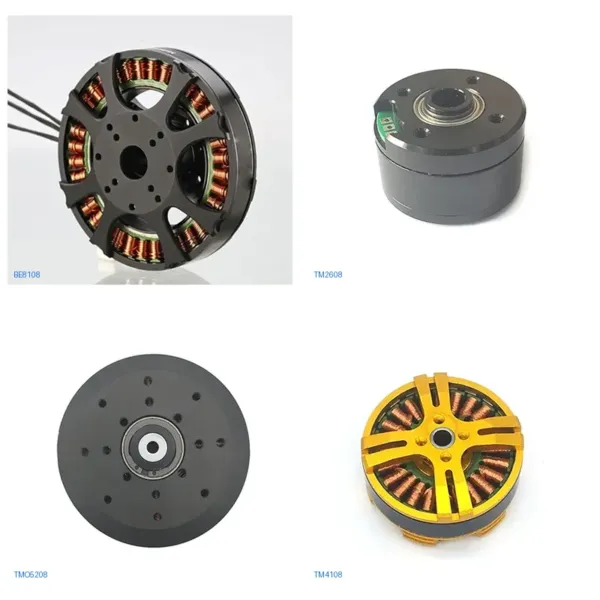
You will find inrunners in EDF (ducted fan) units, RC cars and boats, brushless gimbal motors and industrial spindle motors. A typical drone builder does not use inrunners for propellers, because direct-drive propellers need low-RPM torque rather than high-RPM speed.
Outrunner vs Inrunner: Key Differences
| Property | Outrunner | Inrunner |
|---|---|---|
| Rotor location | Outer bell rotates around stator | Inner rotor spins inside stator |
| Typical kV range | 300 – 2,400 kV | 2,000 – 10,000+ kV |
| Torque | High at low RPM (direct drive friendly) | Lower, needs gearing for high torque |
| Max RPM | Moderate (propeller-limited) | Very high |
| Weight for given torque | Lighter (no gearbox) | Heavier system once geared |
| Typical use | FPV motors, multirotors, RC planes | EDF fans, RC cars, gimbal motors |
Which One Is More Efficient?
Efficiency depends on the operating point, not the topology alone. An outrunner driving a propeller at 60–80% of its no-load speed runs close to its peak efficiency, which is why direct-drive outrunners are the standard for multirotors. An inrunner spun at very high RPM and then geared down loses a few percent in the gearbox, so the total drive efficiency is usually lower than a matched outrunner at the same prop load.
That said, an inrunner is more efficient when the application genuinely needs high shaft RPM, such as an EDF spinning at 40,000+ RPM. Matching the motor type to the load curve matters more than the label on the motor.
Real Motor Examples at Yadovex
| Motor | Type | kV | Best for |
|---|---|---|---|
| 2807-1300KV | Outrunner | 1300 | 5-inch FPV quads, 4S |
| 2807-900KV | Outrunner | 900 | 8–9-inch long-range, 6S |
| 2812-900KV | Outrunner | 900 | Mid-size FPV, 5–7-inch |
| X4215-400KV | Outrunner | 400 | 13-inch heavy-lift, 6S–8S |
How to Choose: Outrunner or Inrunner
Follow three questions before buying:
- What load is on the shaft? Propeller or rotor: outrunner. Ducted fan, wheel or spindle at high RPM: inrunner.
- What RPM range do you need? Below ~10,000 RPM with direct drive: outrunner. Above ~20,000 RPM: inrunner.
- Do you want to avoid a gearbox? Yes: outrunner. A gearbox adds weight, noise and maintenance.
For FPV drones, the answer is essentially always an outrunner. Pick the size by prop diameter, then the kV by cell count: 4S uses 1,400–1,700 kV, 6S uses 900–1,300 kV, and heavy-lift 13-inch rigs use 400–650 kV such as the 4215-650KV.
What Makes Outrunners Better for Drones (Factory Perspective)
This is where the factory difference shows. Two outrunners with the same 28 mm bell can perform very differently depending on manufacturing choices:
- Magnet grade: N52 magnets cost more but raise torque density; cheap N35 magnets lose thrust per gram.
- Silicon steel thickness: 0.20 mm laminations cut eddy-current loss versus 0.35 mm in budget motors, improving efficiency under load.
- Copper fill rate: higher slot fill (more copper in the same stator) lowers resistance and heat at the same current.
- KV tolerance: ±5% matched KV versus ±10% on budget lines means consistent thrust across the four motors on a quad.
- Bearings: steel vs ceramic bearings changes lifespan; every Yadovex motor is individually KV-tested before packing.
Ask your supplier for these specifics before ordering. A cheap outrunner that looks identical can run hotter and weaker than a properly built one.
FAQ
Can I use an inrunner motor on a drone?
Not for direct-drive propellers. Inrunners spin too fast and lack the low-RPM torque to swing a prop efficiently; use an outrunner for any multirotor or plane propeller.
Are all drone motors outrunners?
Nearly all. FPV and multirotor motors such as the 2807, 2812, 3110 and 4215 series are outrunners because propellers need high torque at moderate RPM.
Which is faster: outrunner or inrunner?
An inrunner reaches higher shaft RPM. An outrunner reaches a lower maximum RPM but produces more torque at the RPM propellers actually use.
Do outrunners need a gearbox?
No. The whole point of the large outer bell is to produce enough torque for direct drive; adding a gearbox defeats the weight advantage.
Are inrunners more efficient?
Only when the load needs very high RPM. For propeller loads, a direct-drive outrunner is usually more efficient because no gearbox loss is added.
What kV should I pick for my quad?
Match kV to battery: 4S ~1,400–1,700 kV (e.g. 2807-1500KV), 6S ~900–1,300 kV (e.g. 2807-1300KV), heavy lift 400–650 kV (e.g. X4215-400KV).
Final Verdict
For FPV drones, multirotors and any propeller-driven aircraft, choose an outrunner and stop second-guessing: the low-RPM torque and direct-drive simplicity win. Reserve inrunners for EDFs, cars and high-speed spindles where shaft RPM is the goal.
If you are building a 5-inch quad, start with the 2807-1300KV on 4S, or step up to the X4215-400KV for a 13-inch heavy lifter. Not sure which motor matches your frame? Send your prop size and battery voltage to our team and we will recommend a motor within 24 hours: Contact us or message us on WhatsApp at wa.me/message/POYYRKPKH4VMA1.

Hallen Liu is a product and sourcing specialist at Yadovex, a China-based supplier of FPV and UAV brushless motors, servos and propellers. He works directly with drone builders, distributors and OEM buyers on motor selection, thrust-test data, custom KV and OEM/ODM orders — from sample validation through repeat bulk shipments.