

Brushless vs Brushed Motors for Drones: Which Should You Use?
A brushless motor for drone use is the only practical choice today: it has no brushes to wear out, produces more torque per watt, and lasts for hundreds of flights instead of tens. Brushed motors survive only in the cheapest toys, where cost matters more than flight time. The reason is mechanical, not marketing.
Quick answer
- Brushless (BLDC) = electronic commutation, no brushes → 3–5× longer life, better efficiency, higher power per gram
- Brushed = mechanical commutation through carbon brushes → cheapest possible, but brushes wear and power is limited
- Every serious drone motor is a 3-phase BLDC driven by an ESC; the two main types are outrunner (drones) and inrunner (cars, boats, EDF)
- Brushless costs more up front and roughly half the running cost per flight hour once you count replacements
- For any drone above toy grade, buy brushless. Match KV to the propeller and cell count first
What is a brushed motor?
A brushed DC motor switches its coils mechanically. Carbon brushes press against a rotating commutator, reversing the current in each coil at the right moment to keep the rotor turning. It is simple, cheap and needs no controller — connect two wires and it spins. The catch is contact: brushes are consumable parts, they spark, and they wear away in tens of hours of use.
What is a brushless motor (BLDC)?
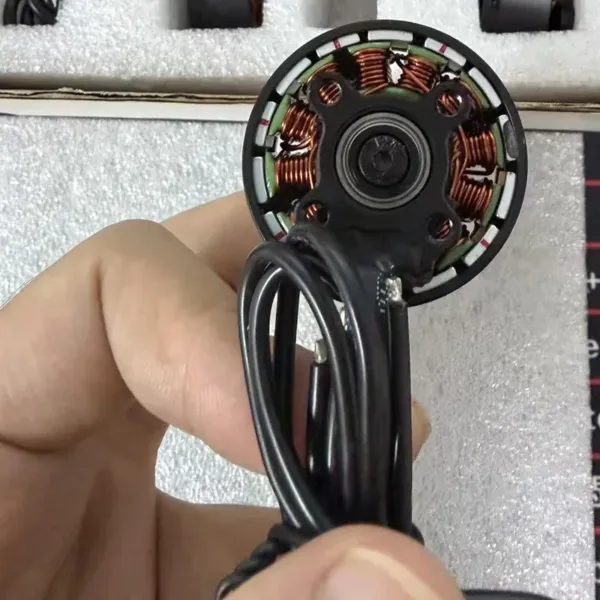
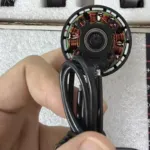
A brushless DC motor moves the switching from the rotor to an electronic speed controller (ESC). The stator carries the windings, permanent magnets turn on the rotor, and the ESC fires the three phases in sequence using rotor position feedback. Nothing touches, so nothing wears. A drone motor is a three-phase BLDC, usually an outrunner with 12 stator slots and 14 magnets (12N14P).
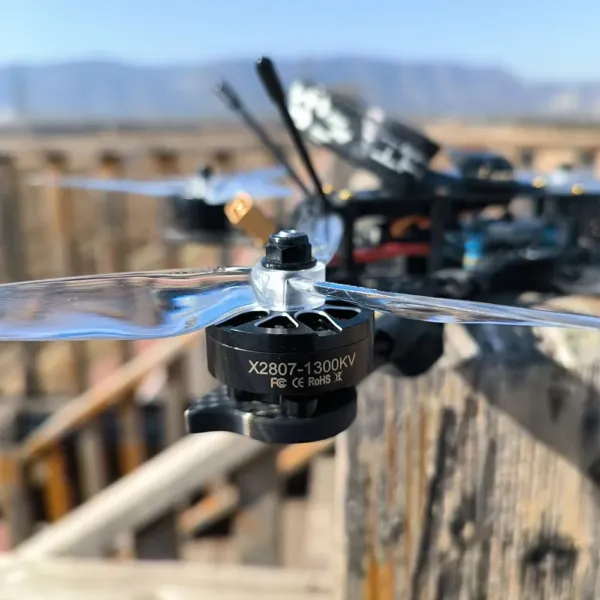
KV describes the winding: RPM per volt with no load. A 2807 1300KV is wound for a 7-inch propeller on 6S; a 2207 at 2400KV is wound for a 5-inch propeller on 4S.
Brushless vs brushed: the comparison
| Commutation | Electronic (ESC) | Mechanical (brushes + commutator) |
| Wear parts | Bearings only | Brushes and commutator |
| Efficiency | Higher, no brush friction | Lower, losses at the contacts |
| Service life | Hundreds of flights | Tens of hours |
| Electronics needed | ESC required | None (2 wires) |
| Cost | Higher up front | Lowest possible |
| Where it is used | All drones, planes, multicopters | Toy-grade drones, small RC |
Why drones need brushless motors
Three reasons decide it. First, a multirotor holds altitude with constant small throttle corrections, so the motor runs continuously for the whole flight — exactly the duty cycle that destroys brushes. Second, weight: a brushless motor delivers more thrust per gram, and every gram saved is flight time. Third, control: an ESC can reverse a brushless motor in milliseconds, which is what makes 3D flying and active braking possible.
A brushless drone motor also fails predictably. Bearings and magnets degrade slowly, while brushes fail suddenly, often mid-flight.
Matching a brushless motor to your build
| 5-inch freestyle / racing | 2206–2306, 1700–2400KV, 4–6S, 5×4.3×3 propeller |
| 7-inch long range | 2807, 1200–1500KV, 6S, 7×3.5×3 or 7x4x3 |
| 9–10 inch long range | 3112–3115, 900KV, 6S, 9×4.5×3 or 10×4.5×3 |
| Heavy lift / agricultural | 4215–5315, 220–650KV, 6–12S, 13–20 inch propeller |
Size the ESC above the peak current in the thrust table, then check the pack continuous rating against the hover current with margin. If you are still choosing a KV, read How to Choose FPV Drone Motors for 6S Long-Range Drones, and for motor construction see Outrunner vs Inrunner Brushless Motors.
What separates a good brushless motor from a cheap one
Every motor in this class is a BLDC, so the label tells you nothing. The difference is in the parts the datasheet skips:
- Magnet grade (N42 / N45 / N52). Higher grades hold flux at temperature, so torque does not fade on a hot pack.
- Stator laminations. 0.35 mm steel is standard; 0.20 mm lowers eddy-current loss at high RPM.
- KV tolerance. Around ±5% on a controlled line against ±10% on a budget one — and mismatched motors make the flight controller fight the airframe.
- Windings and copper fill. Higher fill runs cooler for the same KV.
- Bearings and balance. Sealed bearings and a balanced bell are what keep vibration out of the camera and gyro.
Five questions for any supplier: magnet grade? lamination thickness? KV tolerance and per-unit testing? bearing type? and can they supply a thrust and current table for your propeller and cell count?
How a brushless drone motor is built
A brushless motor is a stack of parts that each decide one behaviour. The stator is built from thin steel laminations, pressed together and wound with copper: the laminations carry the magnetic field, and their thickness sets how much energy is lost as heat at high RPM. The windings set the KV — fewer turns of thicker wire give a higher KV, more turns of thinner wire give a lower one.
The rotor carries the magnets, glued into a machined bell that also holds the shaft and the propeller mount. Magnet grade decides how well the motor holds flux when it gets hot, and the bell is what has to survive a crash. Two bearings support the shaft; a C-clip or grub screw keeps it in place. A well-built motor is dynamically balanced after assembly, because imbalance is what shows up later as jello in your video and drift in your gyro.
Nothing in that list appears on a retail box, which is why two motors at the same size, KV and weight can fly completely differently.
Why brushless motors fail, and how to avoid it
Brushless motors rarely die from the windings. Almost every failure traces back to one of four causes, all of them manageable:
- Bearing wear. Dirt and moisture reach the bearings through prop wash. Sealed bearings and a dry landing area extend life more than any other habit.
- Heat damage to magnets. Running an over-propped motor or a long hover at high throttle pushes magnet temperature past its working range, and torque drops permanently. Size the motor to the propeller, not the other way round.
- Bell damage after a crash. A bent bell or shaft makes the motor vibrate even when it still spins. Replace the bell rather than flying through it.
- ESC and wiring faults. Motor bolts that are too long can touch the windings, and an under-rated ESC will fail before the motor does. Check bolt length and ESC current headroom.
A simple maintenance rule: after every crash, spin the motor by hand and listen. Any roughness means bearings or bell, and flying on it damages the ESC next.
Frequently asked questions
Are brushless motors always better than brushed?
For anything that runs continuously and carries a payload, yes. Brushed motors remain cheaper for toys and very short-run applications where a few hours of life is acceptable.
Do brushless drone motors need an ESC?
Yes. A brushless motor cannot run on DC alone; the ESC switches the three phases and, on modern flight controllers, also provides telemetry and active braking.
How long does a brushless drone motor last?
Life is set by the bearings rather than the windings. With sealed bearings and no crash damage, several hundred flights is normal before service.
Can I replace a brushed motor with a brushless one?
Only with a matching ESC and a compatible mounting pattern. The interfaces differ, so it is usually a redesign rather than a swap.
What does BLDC mean?
Brushless DC. It describes a motor with permanent-magnet rotor and electronically commutated windings, which is what every drone motor is.
Final verdict
If it flies and carries a camera or a payload, use a brushless outrunner: 2206–2306 at 1700–2400KV for 5-inch builds, 2807 at 1200–1500KV for 7-inch long range and 3115 at 900KV for 9 to 10 inch. Brushed motors only make sense when the aircraft is disposable. And buy from a supplier who can answer the five questions above — that is what decides whether the motor still delivers its numbers in month six.
Tell us your frame, propeller and cell count and we will match the motor: contact Yadovex, or browse the full drone motor range and the RC servo range.

Hallen Liu is a product and sourcing specialist at Yadovex, a China-based supplier of FPV and UAV brushless motors, servos and propellers. He works directly with drone builders, distributors and OEM buyers on motor selection, thrust-test data, custom KV and OEM/ODM orders — from sample validation through repeat bulk shipments.