

Outrunner vs Inrunner Brushless Motors: Which One Do You Need?
An outrunner brushless motor spins its outer housing and is the standard choice for drones, planes and multicopters, because it delivers high torque at low RPM. An inrunner keeps its magnets inside a fixed can, spins much faster and fits narrow spaces such as RC cars, boats and ducted fans. Choose by load, cooling and mounting space, not by brand.
Quick answer
- Outrunner = rotating can, typically 12N14P, high torque at low KV → drones, fixed-wing, multicopters
- Inrunner = fixed can, 2–6 poles, high RPM / lower torque → cars, boats, EDFs, some robots
- At the same stator size, an outrunner delivers roughly 2–4× the torque per amp at low RPM
- A 5-inch FPV quad is always an outrunner: 2207 or 2306 class, 1700–2400KV
- Pick an inrunner only when you need high RPM, a slim form factor, or fully sealed cooling
What is an outrunner brushless motor?
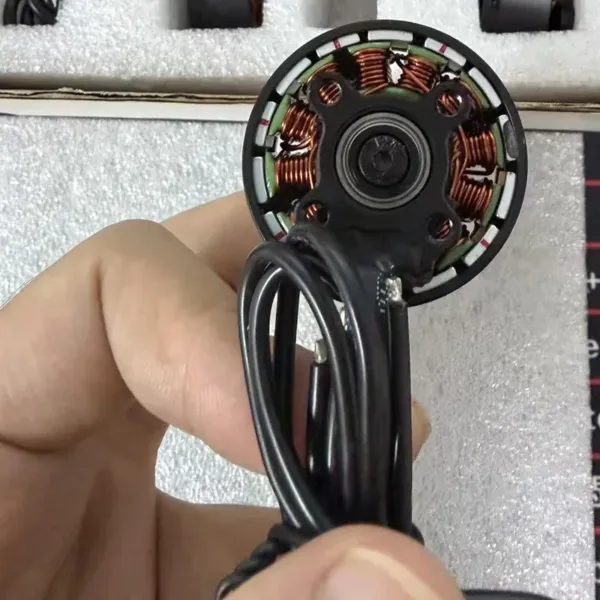
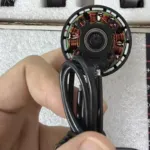
An outrunner motor is a brushless motor whose rotor — the part carrying the permanent magnets — surrounds the stator and rotates on the outside. The bell, and therefore the propeller or gear, turns with it. Because the magnets sit further from the axis, the motor produces useful torque at low rotational speed without a gearbox.
Typical numbers: 12 stator slots and 14 magnets (written 12N14P), KV between 300 and 3000, and a stator named by size — a 2807 is a 28 mm stator diameter with a 7 mm stack height. Outrunners dominate drone propulsion because they can swing a large propeller directly, with no reduction gear to maintain.
What is an inrunner brushless motor?
An inrunner puts the magnets on an inner rotor and the windings in the stationary outer shell. The rotor turns inside the can, so the outside stays fixed. Inrunners usually have 2 to 6 poles, run at very high RPM and produce less torque for their size, which is why they are normally paired with a gearbox or a small high-RPM load such as an EDF unit or a boat prop.
Their fixed outer shell makes cooling easier to duct and lets the motor sit inside a narrow tube — the reason RC cars and boats use them.
Outrunner vs inrunner at a glance
| Structure | Rotating outer can (bell) | Fixed outer can, rotor inside |
| Typical poles | 12N14P and similar | 2 to 6 |
| Torque at low RPM | High | Low |
| RPM range | Low to medium | Very high |
| Propeller | Direct drive, no gearbox | Usually geared or small |
| Cooling | Prop wash over the bell | Ducted air through the can |
| Typical use | Drones, fixed-wing, multicopters | Cars, boats, EDF, robotics |
Torque, KV and propeller size
KV is RPM per volt with no load, so a lower KV motor turns a bigger propeller more slowly and moves more air per watt. That is why long-range builds run lower KV than racing builds.
| Build type | Motor class | KV | Propeller |
| 5-inch FPV racing / freestyle | 2207 / 2306 | 1700–2400KV | 5×4.3×3, 5×4.5×3 |
| 7-inch long range | 2807 | 1200–1500KV | 7×3.5×3, 7x4x3 |
| 9–10 inch long range | 3115 | 900KV | 9×4.5×3, 10×4.5×3 |
| Heavy lift / agricultural | 4215 / 5315 | 220–650KV | 13–20 inch |
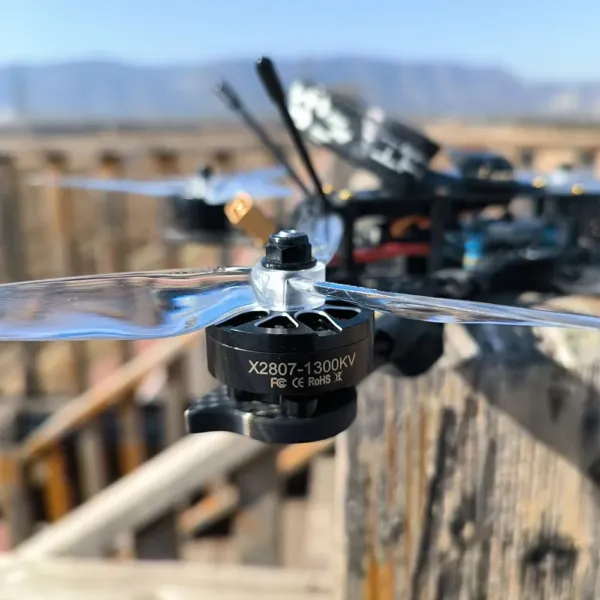
Match the propeller first, then the stator that can turn it, and only then the KV for your cell count. A 2807 1300KV is the middle of the 7-inch band on 6S; a 3115 900KV carries 9 to 10 inch propellers at lower current.
Cooling and efficiency: where the two types differ in practice
An outrunner sheds heat through the bell and the mounting base, and it gets constant airflow from its own propeller. That is why outrunners survive long cruise flights but can overheat in a static test without airflow. An inrunner dumps heat into a fixed aluminium can, which is easier to duct but needs a fan or water jacket when it runs continuously at high RPM.
Efficiency follows current: at the same power, higher voltage and lower current produce less heat in the windings and wiring. This is why 6S and 12S platforms run lower KV outrunners instead of high-KV inrunners with a gearbox.
What the spec sheet does not tell you
Two motors can share the same stator size, KV and weight, and behave completely differently in the air. The differences sit in the parts a datasheet usually omits:
- Magnet grade. N42, N45 and N52 magnets look identical from the outside. A higher grade holds flux better at temperature, which shows up as torque that does not fall away on a hot pack.
- Lamination thickness. Stator steel is commonly 0.35 mm, and 0.20 mm in better motors. Thinner laminations reduce eddy-current losses, which is worth several efficiency points at high RPM.
- KV tolerance. Factory KV is normally held to about ±5% on a good line and ±10% on a budget one. Four motors at ±10% can differ enough that the flight controller has to work harder to keep the craft level.
- Windings. Copper fill factor and a single continuous wind versus hand-soldered joints decide how hot the motor runs under load.
- Balance and bearings. A dynamically balanced bell and decent bearings are what stop vibration from reaching your camera and gyro.
Five questions to ask any motor supplier: (1) What magnet grade do you use? (2) What is your stator lamination thickness? (3) What is the KV tolerance, and do you test every unit? (4) Which bearings, and are they sealed? (5) Can I get a thrust and current table for my exact propeller and cell count?
A supplier who cannot answer these is repackaging someone else’s motors.
Which one do you need?
- Multirotor, fixed-wing or any direct-drive propeller: outrunner.
- RC car, boat or ducted fan: inrunner, usually with a gearbox.
- Robot joint or gimbal: a low-KV outrunner with a hollow shaft or a purpose-built gimbal motor.
- You need high RPM in a slim tube: inrunner.
- You need torque at low RPM without gears: outrunner.
Frequently asked questions
Is an outrunner better than an inrunner?
Neither is universally better. Outrunners win on torque at low RPM and suit propellers; inrunners win on RPM and slim packaging and suit cars, boats and EDFs.
Why do drones use outrunner motors?
Because a drone propeller needs torque at moderate RPM, and an outrunner delivers that directly without a gearbox, which removes weight, maintenance and a failure point.
Can I use an inrunner on a drone?
Yes, but normally with a gearbox or a small high-RPM propeller. Direct-drive multirotors almost always use outrunners because the propeller is large relative to the motor.
Does KV decide whether a motor is an outrunner or an inrunner?
No. KV describes the winding, not the construction. You can find both types at the same KV; the difference is where the magnets sit and how the motor is cooled.
How do I read a motor number like 2807 or 3115?
The first two digits are the stator diameter in millimetres and the last two are the stator stack height: 2807 is 28 mm by 7 mm, 3115 is 31 mm by 15 mm.
Final verdict
For any propeller-driven aircraft, choose an outrunner: a 2207 or 2306 at 1700–2400KV for 5-inch builds, a 2807 at 1200–1500KV for 7-inch long range, and a 3115 at 900KV for 9 to 10 inch or light-lift platforms. Reach for an inrunner only when you genuinely need high RPM in a narrow package. And whatever you buy, ask the five questions above — the answers separate a motor that holds its numbers from one that only looks like it.
Need help matching a motor to your frame and propeller? Send us the build details and we will quote it, or browse the full drone motor range. For KV and propeller maths, read How to Choose FPV Drone Motors for 6S Long-Range Drones.

Hallen Liu is a product and sourcing specialist at Yadovex, a China-based supplier of FPV and UAV brushless motors, servos and propellers. He works directly with drone builders, distributors and OEM buyers on motor selection, thrust-test data, custom KV and OEM/ODM orders — from sample validation through repeat bulk shipments.