Servo vs Stepper Motor: Which One Do You Need?
A servo motor is a closed-loop position motor that moves to a commanded angle and holds it, while a stepper motor is an open-loop motor that moves in fixed steps. For most RC, drone and robot-arm hobbyists, servos win: they are lighter, cheaper per kg·cm, respond faster and hold position without continuous power logic. Steppers earn their place in precise open-loop positioning such as 3D printers, CNC and camera sliders, where absolute repeatability matters more than speed or holding torque.
Quick Answer: Servo vs Stepper
- Servo: closed-loop, moves to an angle (typically 0–180°, or 270°/360° continuous), holds position with torque, lighter, faster — ideal for RC, drones, robot arms, boat rudders.
- Stepper: open-loop, moves in fixed steps (e.g. 1.8° per step = 200 steps/rev), holds position magnetically, heavier, slower — ideal for 3D printers, CNC, camera sliders.
- Servos need only a PWM signal; steppers need a driver and step/dir pulses (or a controller).
- If you need fast, strong, compact motion with feedback: servo. If you need repeatable open-loop positioning: stepper.
What Is a Servo Motor?
A servo is a closed-loop actuator: a DC or brushless motor drives a gear train, a position sensor (potentiometer or encoder) reads the output angle, and the control board compares the commanded PWM signal to the measured angle, driving the motor until they match, then holding. Because of the feedback loop, a servo always reaches and holds its commanded position under load — that is the key difference from a stepper.
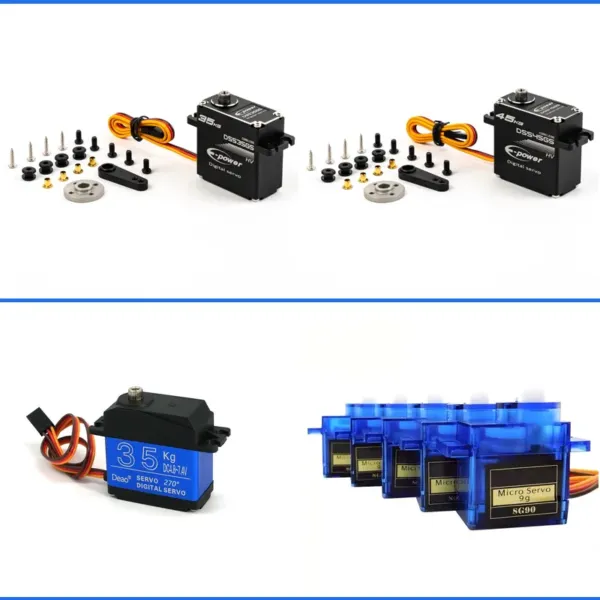
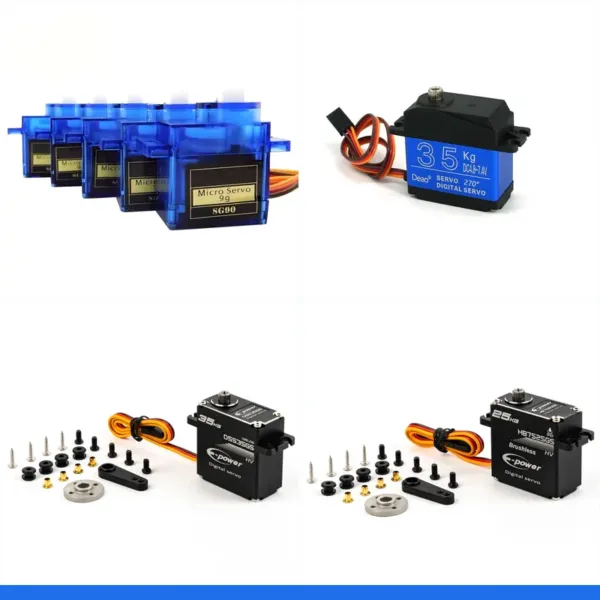
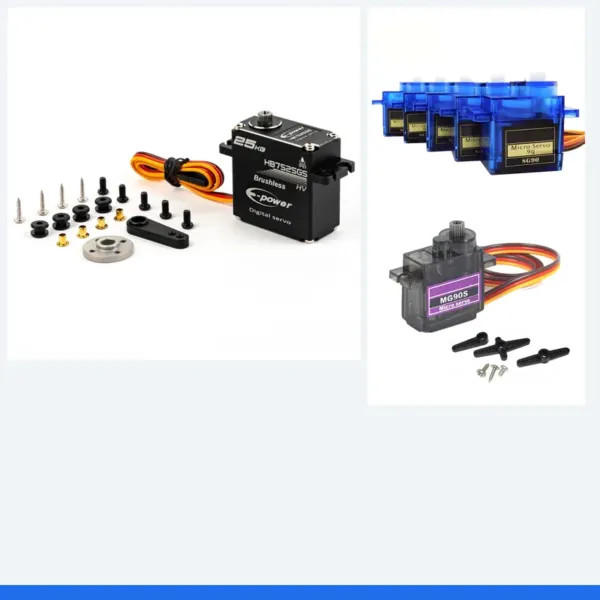
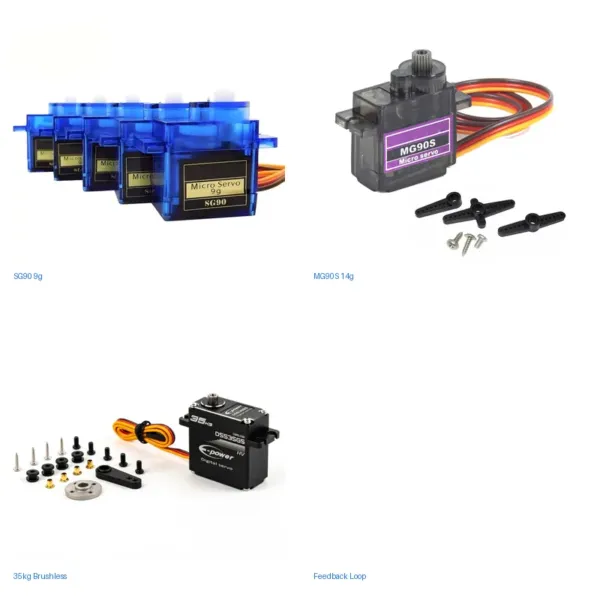
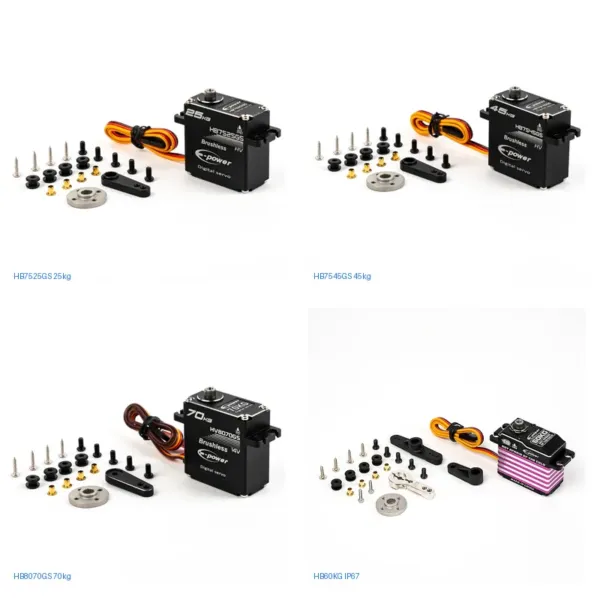
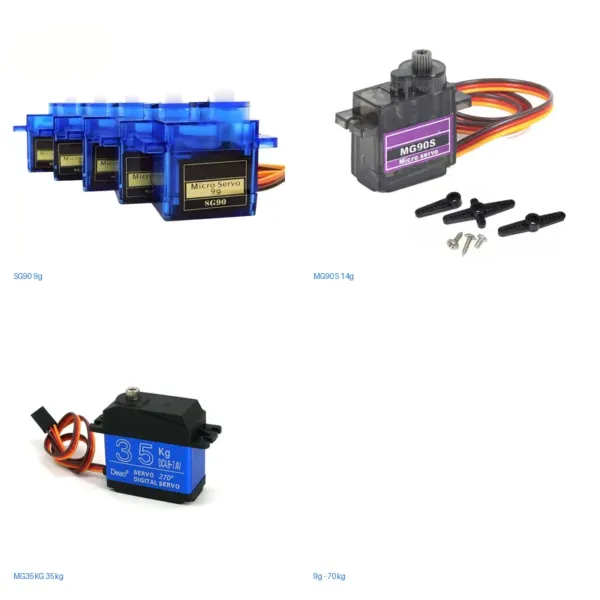
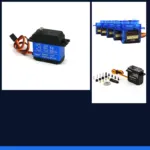
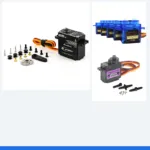
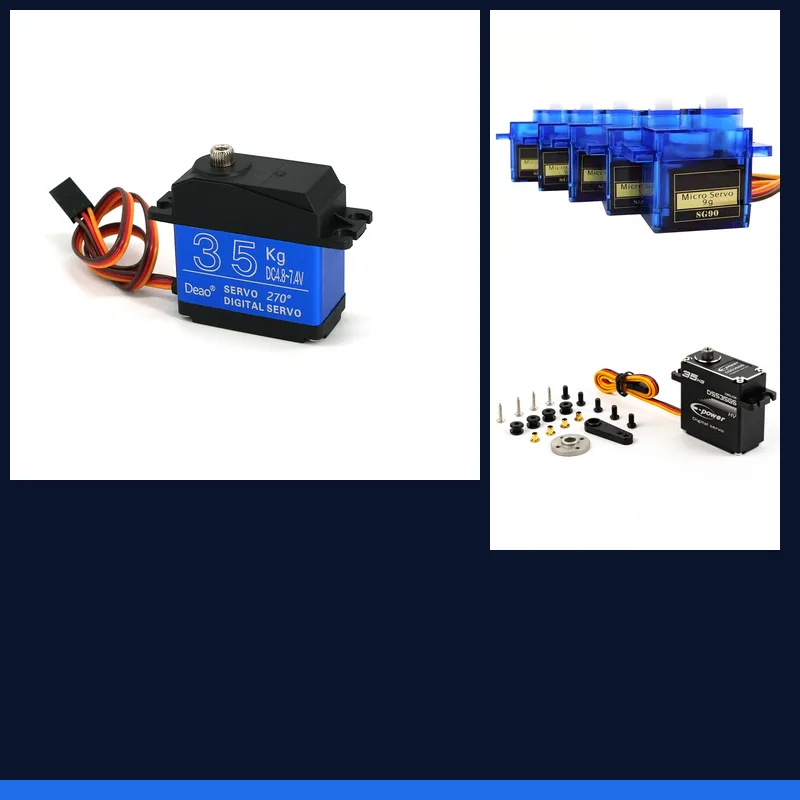
Yadovex servos cover the practical range: from SG90 9g micro servos for small models to HB45KG 45kg brushless waterproof units for boats, crawlers and robot arms, with 180°, 270° and 360° rotation options.
What Is a Stepper Motor?
A stepper motor is an open-loop motor with multiple coils (phases) arranged around the rotor. By energizing the coils in sequence, the motor rotates in precise, fixed increments — typically 1.8° per step (200 steps per revolution) or 0.9° (400 steps). No feedback sensor is needed: as long as the steps are not skipped, the position is known exactly from the step count. If the load exceeds the torque, steps are lost and position drifts without the motor knowing.
Servo vs Stepper: Key Differences
| Property | Servo Motor | Stepper Motor |
|---|---|---|
| Control loop | Closed-loop (feedback sensor) | Open-loop (step counting) |
| Position | Absolute angle, holds with torque | Relative steps, holds magnetically |
| Speed | Fast response | Slow (torque drops at high RPM) |
| Torque at speed | Holds torque while loaded | Loses torque at high step rates |
| Weight for same torque | Lighter | Heavier |
| Control signal | 1–2ms PWM (standard receiver compatible) | Step/Dir pulses + driver |
| Cost | Wide range, from budget to premium | Motor + driver + controller |
| Typical use | RC, drones, robot arms, boats | 3D printers, CNC, camera sliders |
Real Servo Examples at Yadovex
| Servo | Torque | Speed | Best for |
|---|---|---|---|
| SG90 9g | ~1.8kg·cm | 0.10s/60° | Micro planes, small models |
| MG90S 14g | ~2.2kg·cm | 0.10s/60° | Robot arms, small RC |
| MG35KG | 35kg·cm | 0.18s/60° | RC cars, crawlers |
| D5535GS | 35kg·cm | 0.07s/60° | Fast coreless, waterproof |
| HB45KG | 45kg·cm | 0.08s/60° | Boats, crawlers, IP67 |
When to Choose a Servo
Choose a servo when you need fast, strong, compact motion with feedback:
- Any RC application: planes, cars, boats, crawlers — servos plug straight into the receiver.
- Drone gimbals, camera tilt, landing gear — light and responsive.
- Robot arms and bionic hands — servos hold position under load without hunting.
- Waterproof or heavy-duty builds — brushless servos such as the HB series offer IP67 sealing.
When to Choose a Stepper
Choose a stepper when you need repeatable open-loop positioning:
- 3D printer axes — X/Y/Z movement with exact step counts.
- CNC and laser engravers — predictable feed rates.
- Camera sliders and pan-tilt rigs that move slowly and precisely.
- Any application where position must be exact without a feedback sensor.
Factory Perspective: What Really Differs in Build Quality
Servo quality is not only about the motor — it is about the whole assembly. When you buy servos for a product line, check these factory-level details:
- Gear material: full steel gears (MG30KG, MG35KG) survive crash loads; metal-copper gears (MG20KG, MG25KG) are quieter but softer.
- Motor type: coreless (D5535GS, D5555GS) and brushless (HB series) respond faster and last longer than standard cored motors.
- Deadband and centering: a factory-set deadband of 1–2µs separates a servo that centers crisply from one that hunts.
- Sealing: real IP67 needs dual gaskets and a sealed output shaft — verify the rating, not the marketing text.
A stepper, by contrast, is simpler: the quality markers are the coil count, step accuracy and driver current handling. For a servo-driven product, the gear train and feedback sensor decide the lifespan.
FAQ
Can a servo replace a stepper motor?
Not directly. Servos use a PWM signal and close the loop internally; steppers need a driver and step pulses. They are different control ecosystems, so pick by application, not by swapping parts.
Are servos more expensive than steppers?
At the hobby level, servos are often cheaper and lighter for the same torque. Stepper systems cost more once you add the driver and controller.
Which is better for a robot arm?
For most hobby and light-duty robot arms, servos are better: they are compact, hold torque and plug into standard controllers. Steppers suit heavier industrial arms with full drivers.
Do stepper motors need feedback?
No — that is the point of open-loop control. Position is inferred from step count. If the load stalls the motor, steps are lost silently, so critical applications add an encoder.
Are servo motors faster than stepper motors?
Yes, in practice. Servos respond in milliseconds and hold torque under load; steppers lose torque rapidly at high step rates.
Can a stepper be used for a drone?
No. Steppers are too heavy and slow for propellers; brushless outrunners or servos are the right choice for drones.
Final Verdict
For RC, drones, boats, crawlers and most robot-arm hobby builds, choose a servo: it is lighter, faster, holds torque and needs only a PWM signal. Reserve steppers for 3D printers, CNC and camera sliders where open-loop step positioning is the requirement.
If you are building a robot arm or a boat, the MG35KG (full steel gears) or the HB45KG (IP67 brushless) are strong starting points. Tell us your application, torque and voltage, and we will match the right servo within 24 hours: Contact us or message us on WhatsApp at wa.me/message/POYYRKPKH4VMA1.

Hallen Liu is a product and sourcing specialist at Yadovex, a China-based supplier of FPV and UAV brushless motors, servos and propellers. He works directly with drone builders, distributors and OEM buyers on motor selection, thrust-test data, custom KV and OEM/ODM orders — from sample validation through repeat bulk shipments.