Brushed vs Coreless Servo: Which Type Should You Choose?
A coreless servo uses a rotor made of a self-supporting basket winding with no iron core, while a brushed servo (the standard type) uses a conventional iron-core rotor with brushes and a commutator. Coreless servos spin up faster, respond quicker, draw less current for the same torque and run smoother — which is why racing drivers and fast robot arms use them. Brushed servos remain cheaper and fully adequate for micro models, sport planes and budget builds. The practical rule: buy coreless when response speed and holding precision matter; buy brushed when size, price and simplicity matter.
Quick Answer: Brushed vs Coreless Servo
- Coreless: no iron core in the rotor, lower inertia, faster acceleration, higher resolution, smoother motion — costs 30–60% more than an equivalent brushed servo.
- Brushed: iron-core rotor with brushes, more inertia, slower to accelerate — cheapest per kg·cm and available everywhere.
- Both use the same 1–2ms PWM signal and work with any standard receiver.
- Coreless wins at high torque and fast direction changes; brushed wins at small sizes and low duty cycles.
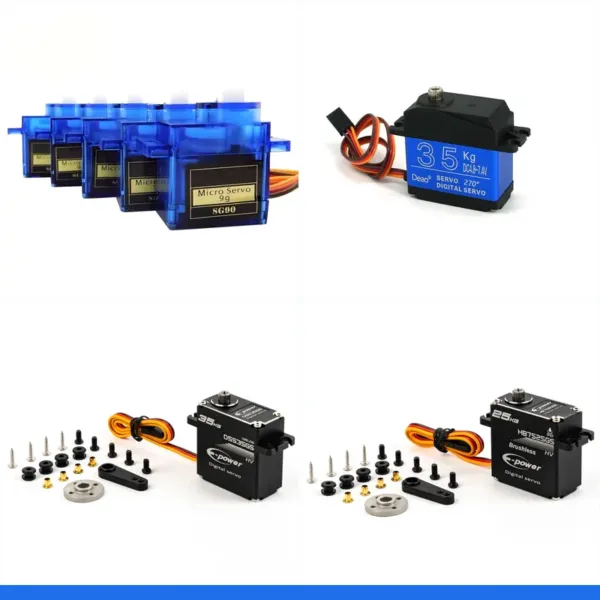
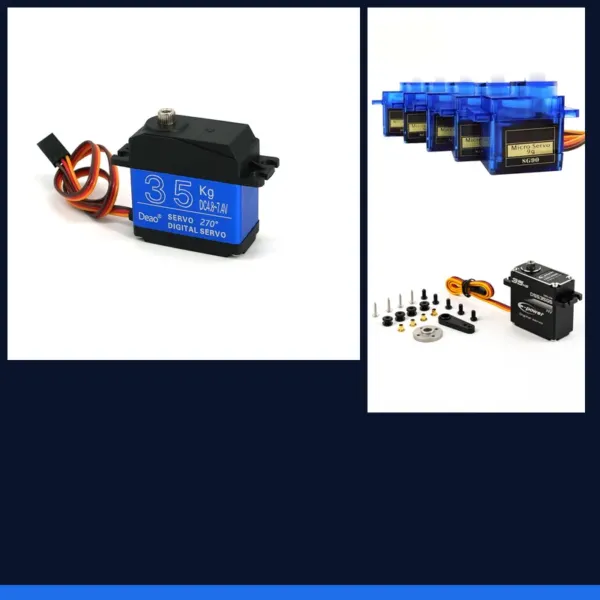
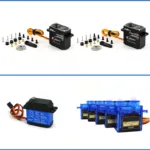
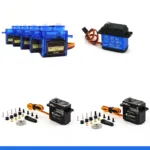
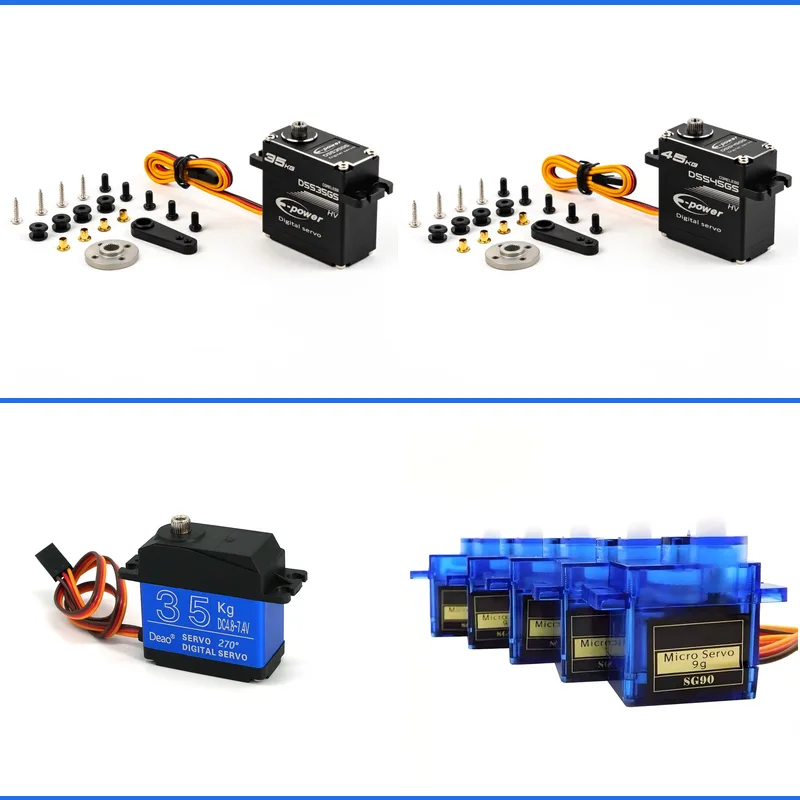
- Waterproof and high-torque servos such as the D5535GS and D5555GS are coreless; basic micro servos such as the SG90 are brushed.
What Is a Brushed Servo?
A standard brushed servo contains a small DC motor with a wound iron-core rotor. Carbon brushes press against a commutator to reverse the winding current as the rotor turns. The iron core concentrates the magnetic flux, which produces decent torque, but it also adds mass and inertia: the rotor resists acceleration, so the servo takes longer to start, stop and reverse.
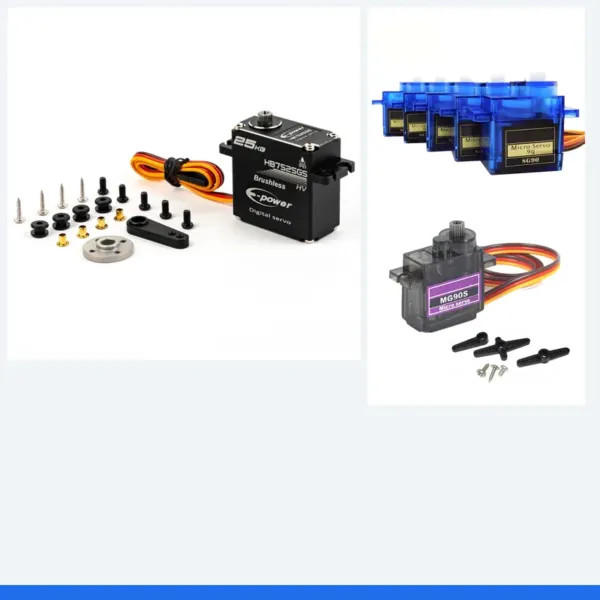
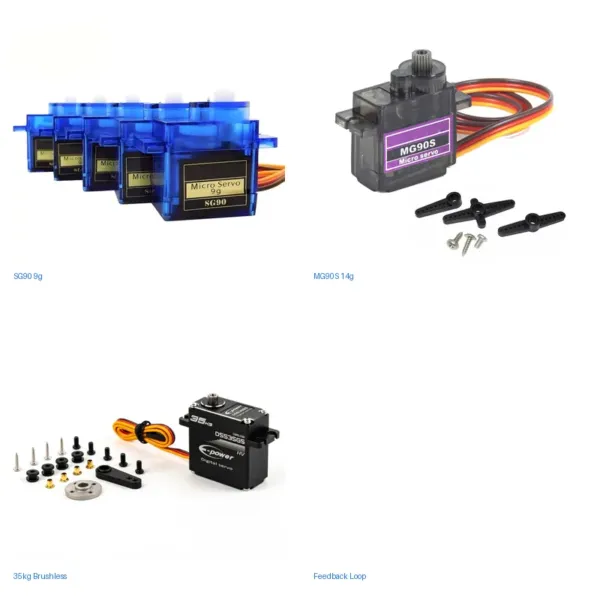
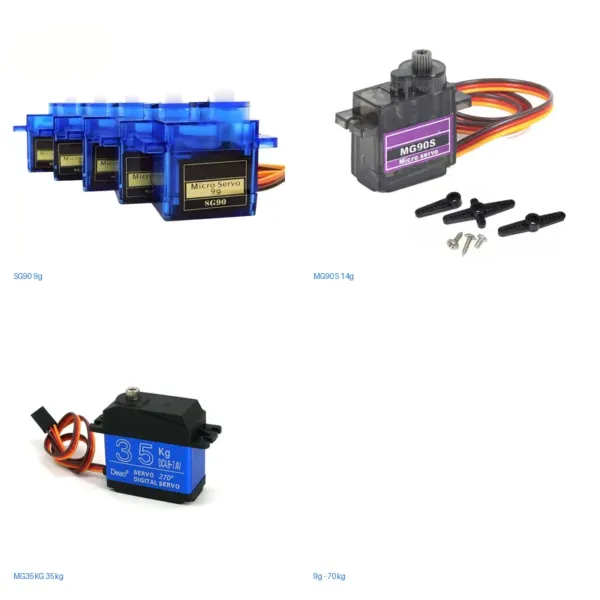
Brushed servos are the workhorses of the hobby world. The SG90 9g and MG90S 14g are classic examples: light, cheap, and perfectly matched to small control surfaces where the servo moves occasionally rather than constantly. The brushed MG line — MG20KG, MG25KG, MG30KG and MG35KG — shows how far brushed technology can be pushed: 20–35kg·cm with metal or full-steel gears is more than enough for a crawler or a heavy robot arm.
What Is a Coreless Servo?
A coreless servo replaces the iron-core rotor with a hollow, self-supporting basket winding — often called a “coreless” or “moving coil” motor. Because there is no iron in the rotor, the rotating mass drops dramatically. Lower inertia means the motor accelerates and decelerates faster, stops more precisely and produces less vibration at the same operating point. There is also no iron-core cogging torque, so motion feels smoother and the servo holds position with less hunting.
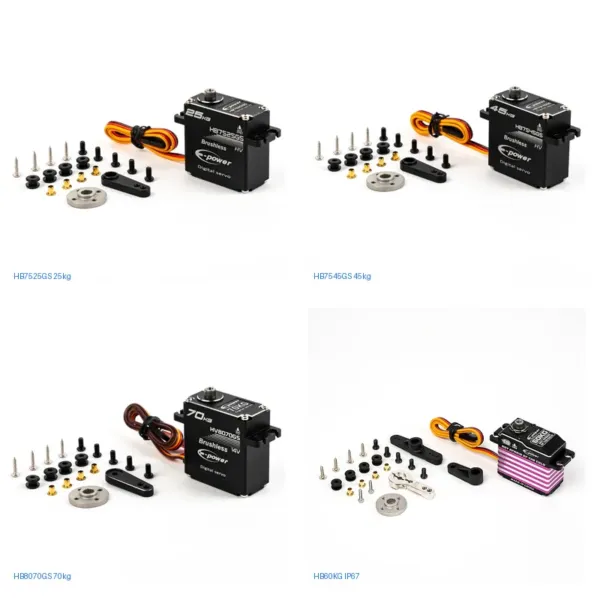
Yadovex coreless servos cover the performance end of the range: the D5535GS (35kg·cm, 0.07s/60° at 7.4V), the D5545GS (45kg·cm, 0.11s/60° at 8.4V) and the D5555GS (55kg·cm, 0.08s/60° at 8.4V). All three use metal gears and an aluminum case, and the first two are waterproof.
Brushed vs Coreless Servo: Key Differences
| Property | Brushed Servo | Coreless Servo |
|---|---|---|
| Rotor construction | Iron-core winding with brushes | Hollow basket winding, no iron core |
| Rotor inertia | Higher (iron mass) | Very low |
| Acceleration / response | Slower to start and reverse | Fast acceleration, sharper response |
| Resolution and smoothness | Good, some cogging | Higher, no cogging torque |
| Efficiency at same torque | Lower (core losses) | Higher (no core losses) |
| Heat at same load | Higher | Lower |
| Price | Lower | Higher (30–60% more) |
| Typical use | Micro models, sport planes, budget builds | Racing, heavy crawlers, robot arms, UAVs |
Why Coreless Motors Respond Faster
The difference comes down to physics. Torque must accelerate the rotor, and acceleration is inversely proportional to inertia. A conventional iron-core rotor weighs several grams; a basket winding of the same electrical strength weighs a fraction of that. Lower inertia means the servo reaches its commanded position faster and settles with less overshoot.
That is why a coreless servo such as the D5535GS can achieve 0.07s/60° while a brushed servo of similar torque typically needs 0.13–0.18s/60°. In a racing car, that difference is the difference between catching a slide and losing the car. In a robot arm, it shows up as crisper, more repeatable moves with less vibration at the endpoint.
Real Servo Examples at Yadovex
| Servo | Type | Torque | Speed | Best for |
|---|---|---|---|---|
| SG90 9g | Brushed | ~1.8kg·cm | 0.10s/60° | Micro planes, small models |
| MG90S 14g | Brushed | ~2.2kg·cm | 0.10s/60° | Robot arms, small RC |
| MG35KG | Brushed digital | 35kg·cm | 0.18s/60° | RC cars, crawlers |
| D5535GS | Coreless | 35kg·cm | 0.07s/60° | Racing, crawlers, waterproof |
| D5545GS | Coreless | 45kg·cm | 0.11s/60° | Heavy cars, boats, robot arms |
| D5555GS | Coreless | 55kg·cm | 0.08s/60° | Heavy UAV, large RC models |
When Brushed Is the Right Choice
Brushed servos are not obsolete — they are simply matched to different jobs. Choose brushed when:
- The servo moves occasionally. Control surfaces on a sport plane do not need millisecond response; a brushed servo lasts for years.
- Weight and space are tight. A 9g brushed micro servo fits where a coreless cannot.
- Budget matters. For a school project, a small robot kit or a first RC build, brushed is the sensible entry point.
- You need a proven replacement. Brushed servos are standardised, widely available and easy to swap.
When Coreless Is Worth the Extra Cost
Coreless servos cost more, and they earn it in four situations:
- Racing and aggressive driving. Faster centering and lower inertia mean the car follows the steering input more faithfully.
- Heavy loads that must be held precisely. 35–55kg·cm coreless servos with metal gears hold position without sagging or hunting.
- Vibration-sensitive applications. No cogging torque means smoother motion for camera rigs and robot arms.
- Continuous duty. Higher efficiency and lower heat at the same torque extend service life in robots and UAVs.
Battery, Heat and Lifetime: What Actually Changes
Because a coreless rotor has no iron losses, it converts more of the electrical input into motion and less into heat. In practice this means three things:
- Lower running temperature. A coreless servo doing the same work runs cooler, which protects the gears and the control board.
- Better voltage sag tolerance. Lower resistance and higher efficiency mean the servo keeps its speed closer to the rated figure as the battery drains.
- Longer brush and gear life. Less heat and smoother motion reduce wear on both the brushes and the gear train.
Those benefits matter most in continuous-use applications — a robot arm cycling all day, a crawler running a full battery, a boat servo working in salt water. For a model that flies for eight minutes on weekends, the difference is negligible.
Installation Notes That Apply to Both Types
The motor type does not change the installation rules. These five points decide whether a servo lives or dies:
- Power budget. High-torque servos draw 1–3A peaks; use a BEC rated for the total current.
- Endpoints. Set EPA or travel limits so the servo never stalls against a mechanical stop.
- Horn length. A longer arm multiplies torque but increases load and slows centering; keep it as short as the application allows.
- Sealing. If you buy a waterproof coreless servo, check the output-shaft seal after every crash or disassembly.
- Centering check. Power the servo and confirm it centers before mounting it into a linkage.
Factory Perspective: How to Tell a Good Coreless Servo
Coreless construction is easy to claim and harder to build well. When evaluating a supplier, ask for these specifics:
- Winding quality. A basket winding must be self-supporting and precisely formed; poor winding shows up as vibration and inconsistent torque.
- Gear material. Metal gears (as on the D5535GS and D5545GS) handle crash loads; plastic gears will strip under the same torque.
- Speed consistency. Two servos from the same batch should reach 60° within a few hundredths of a second of each other.
- Deadband. A factory-set deadband of 1–2µs separates a servo that centers crisply from one that hunts.
- Test data. Ask for torque and speed test results at the rated voltage — not catalogue numbers copied from a reference sheet.
These details are what separate a coreless servo that performs like the specification from one that merely carries the label. They are also why the same “35kg coreless” can feel completely different from two different factories.
FAQ
Is a coreless servo better than a brushed servo?
Not universally. Coreless is better for speed, smoothness and efficiency at high torque; brushed is better for price, small size and light-duty use.
Are coreless servos worth the extra money?
For racing, heavy crawlers, robot arms and continuous duty, yes. For a sport plane or a first RC build, a brushed digital servo is usually enough.
Do coreless servos last longer?
Usually yes, because they run cooler and smoother at the same load. Gear quality and installation still decide the real lifespan.
Can I use a coreless servo with my existing receiver?
Yes. Coreless servos use the same 1–2ms PWM signal as brushed servos and plug into any standard receiver.
Why are coreless servos faster?
Because the rotor has no iron core, its inertia is much lower, so it accelerates and reverses faster for the same torque.
Do coreless servos need more current?
At the same torque they usually draw slightly less, because efficiency is higher. Peak current during fast moves can still be high, so size the BEC for the peak.
Are coreless servos waterproof?
Some are, such as the D5535GS and D5545GS. Waterproofing is a separate design feature — check the IP rating rather than assuming it from the motor type.
Final Verdict
Choose coreless when response speed, smoothness or sustained high-torque work justifies the extra cost: racing, heavy crawlers, robot arms, boats and UAVs. Choose brushed for micro models, sport planes and budget builds where the servo moves occasionally and price matters.
If you are upgrading a crawler or a robot arm, the D5535GS (35kg·cm, 0.07s) is the fastest entry point; step up to the D5545GS (45kg·cm) or D5555GS (55kg·cm) for heavier loads. Tell us your application, torque and voltage, and we will match the right servo within 24 hours: Contact us or message us on WhatsApp at wa.me/message/POYYRKPKH4VMA1.

Hallen Liu is a product and sourcing specialist at Yadovex, a China-based supplier of FPV and UAV brushless motors, servos and propellers. He works directly with drone builders, distributors and OEM buyers on motor selection, thrust-test data, custom KV and OEM/ODM orders — from sample validation through repeat bulk shipments.