How to Choose Drone Propellers: Size, Pitch, Material and Real Thrust Data
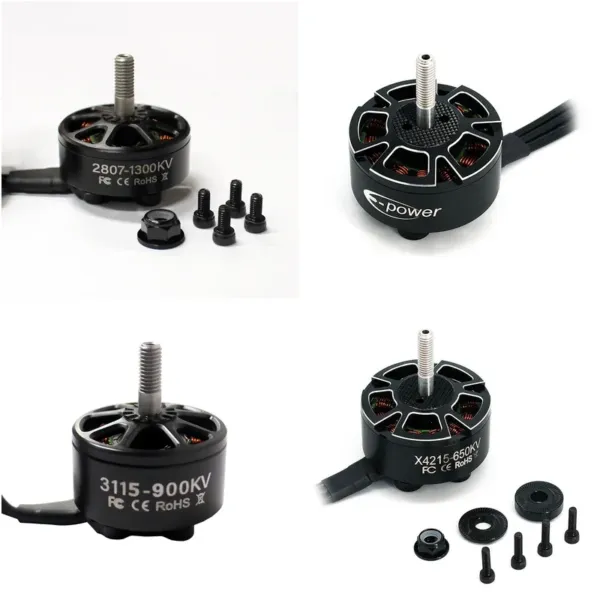
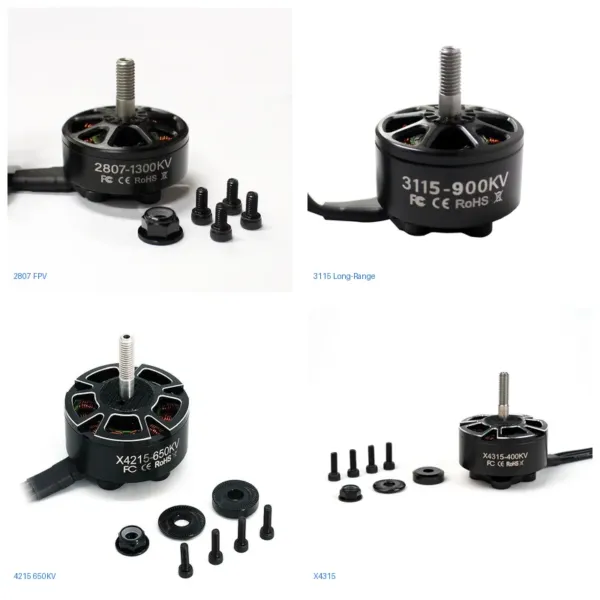
A drone propeller is sized by three numbers — diameter, pitch and blade count — and the first rule of choosing one is to match the diameter to your motor size and the pitch to your flying style. For a 5-inch FPV quad pair 5-inch props with 2207 or 2306 motors; for a 7-inch long-range build use 7-inch props on 2807 motors; and for heavy-lift or fixed-wing platforms step up to 9-15 inch props on 3115 or larger motors. Material matters too: polycarbonate for freestyle durability, glass-fiber reinforced nylon for long-range and heavy-lift efficiency, and carbon-fiber composite for the lightest fixed-wing setups. This guide breaks down the selection with real thrust-test data from our 3115-900KV motor.
- 5-inch freestyle/racing: 5X4.3X3 or 5X4.5X3 polycarbonate props on 2207/2306 motors.
- 7-inch long range: 7X4X3 or 7.5X3.7X3 props on 2807-class motors.
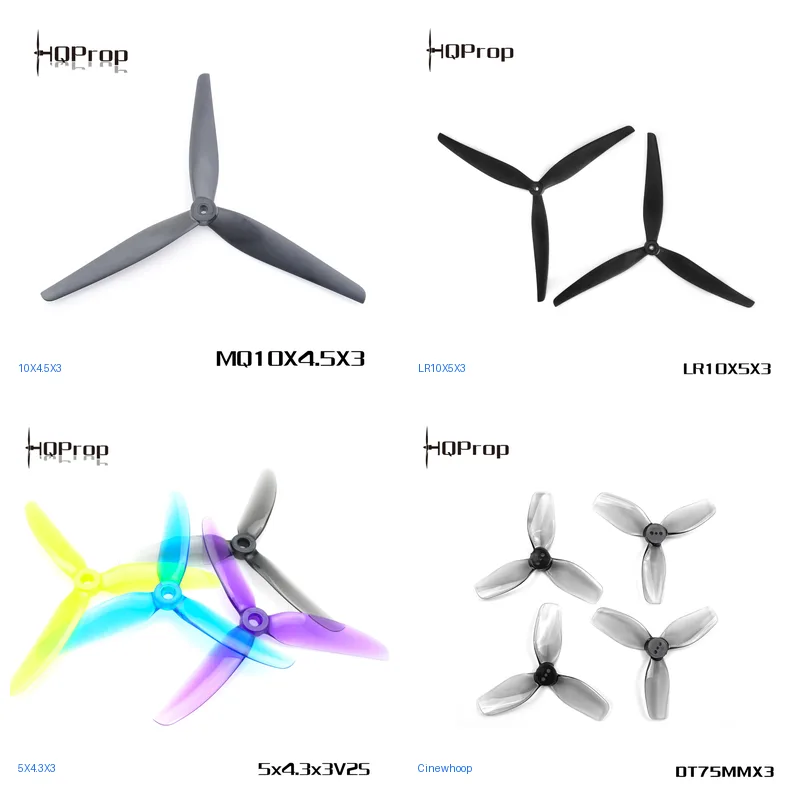
- 9-10 inch heavy lift / macroquad: HQ MacroQuad or LR10X5X3 glass-fiber nylon props on 3115 motors — our test showed 3.01 kg thrust at full throttle.
- 15-inch fixed wing / agricultural: 15X10X3 glass-fiber reinforced nylon on 4215-class motors.
Reading Propeller Numbers: Diameter, Pitch, Blade Count
Every drone propeller carries a three-part code, and each number changes how the prop behaves:
| Number | What it means | Effect |
|---|---|---|
| Diameter (first number) | Prop width in inches (5, 7, 10, 15) | Larger = more thrust but needs a bigger motor and more current |
| Pitch (second number) | Theoretical forward travel per revolution | Higher pitch = more speed, lower pitch = more torque and efficiency |
| Blade count (third number) | 2, 3, 4 or 5 blades | More blades = smoother and more grip, but lower efficiency |
A 10X4.5X3 prop, for example, is 10 inches in diameter, 4.5 inches of pitch, and 3 blades. The same diameter with more pitch (10X5X3) flies faster at full throttle but draws more current; the same diameter with fewer blades is more efficient.
Matching Propeller Size to Your Motor
The single most reliable way to choose a drone propeller is to start from the motor size, then set the pitch by flying style. Here is the pairing matrix that covers the Yadovex range:
| Motor class | Typical builds | Recommended prop size |
|---|---|---|
| 2207 / 2306 | 5-inch racing & freestyle quads | 5X4.3X3, 5X4.5X3, or 5X5X3 |
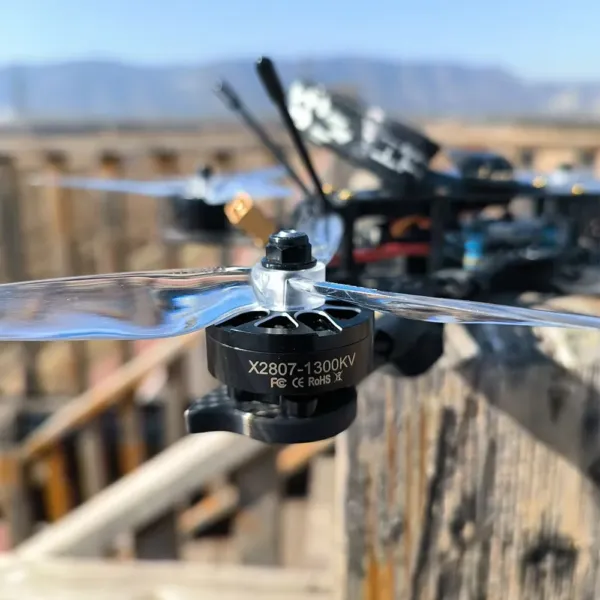
| 2807 | 7-inch long-range & cinematic | 7X3.5X3, 7X4X3, 7.5X3.7X3 |
| 3115 | 9-10 inch macroquad & heavy lift | 9X4.5X3, 10X4.5X3, LR10X5X3 |
| 4215 / larger | 15-inch fixed wing & agricultural | 14X8X3, 15X10X3 |
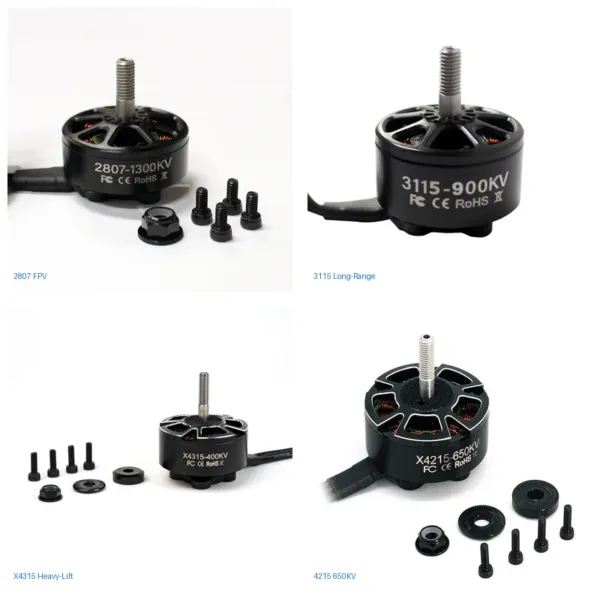
If you are moving from one prop size to another on the same drone, a safe rule is to change diameter in one-inch steps and re-check motor temperature. A prop that is too large makes the motor draw too much current and overheat; too small wastes the motor’s torque. Our 3115-900KV motor and 2807-1300KV product pages list the prop ranges they are designed for.
Propeller Materials: Polycarbonate vs Glass-Fiber Nylon vs Carbon
Material choice is the second-biggest decision after size. The three materials used across our 27 HQProp models behave very differently:
| Material | Best for | Trade-offs |
|---|---|---|
| Polycarbonate (PC) | Freestyle, racing, cinewhoop | Tough and flexes on impact, but heavier and slightly less efficient |
| Glass-fiber reinforced nylon | Long-range, cinematic, heavy-lift | Stiff yet flexible — won’t shatter; the durability standard for efficiency builds |
| Carbon-fiber composite | Fixed-wing, lightweight builds | Lightest and stiffest, but brittle — one bad impact can crack it |
Glass-fiber reinforced nylon is the material that dominates long-range and heavy-lift propellers, because the fiber content adds stiffness while the nylon lets the blade flex slightly instead of shattering on a hard landing. If you fly freestyle and crash often, polycarbonate is the more forgiving choice; if every gram of efficiency matters, go glass-fiber nylon or carbon.
Choosing by Application: Our HQProp Range Grouped
Yadovex carries 27 genuine HQProp models. Here is how they group by use case:
| Application | Prop models |
|---|---|
| FPV racing & freestyle | R42 (5X4.2), 5X4.3X3 V1S/V2S, 5X4.5X3 V1S/V3, 5X5X3 V1S |
| Long range | LR10X5X3, 7X3.5X3, 7X4X3, 7.5X3.7X3 |
| Macroquad / heavy lift | MacroQuad 7X4.5X3, 8X4X3, 9X4.5X3, 9X5X3, 10X4.5X3 |
| Cinewhoop | DT75MMX3, D76MMX3, DT90MMX5 |
| Whoop / micro | 40MMX2 ultralight, 65MM micro, 1.6X1.6X4 and 1.2X1.2X4 whoop |
| Fixed wing / agricultural | Thin Electric 6X4.5E, E-10X5, 11X5; HQProp 14X8X3, 15X10X3 |
Each of these is a genuine HQProp product — we source directly from the manufacturer — so the performance you see in reviews matches what ships. Two good places to start browsing are the racing & freestyle props and long-range props collections.
Real Thrust-Test Data: 10X4.5X3 vs LR10X5X3 on a 3115-900KV Motor
Spec sheets are fine, but what matters is what a prop actually does on a motor. Below is our measured test data (3115-900KV motor, 6S) for two 10-inch props from different build philosophies — the MacroQuad 10X4.5X3 for heavy-lift multirotors and the LR10X5X3 for long range:
| Throttle | 10X4.5X3 thrust | 10X4.5X3 RPM | LR10X5X3 thrust | LR10X5X3 RPM |
|---|---|---|---|---|
| 30% | 0.12 kg | 3,139 | 0.13 kg | 3,000 |
| 50% | 0.74 kg | 6,988 | 0.83 kg | 6,815 |
| 70% | 1.79 kg | 10,596 | 1.95 kg | 10,200 |
| 100% | 2.84 kg | 13,210 | 3.01 kg | 12,554 |
Two useful conclusions from real data. First, the higher-pitch LR10X5X3 delivers more thrust at every throttle point (3.01 kg vs 2.84 kg at 100%), which is why it is the long-range choice — more push per watt. Second, the 10X4.5X3 spins faster (13,210 vs 12,554 RPM) with the same throttle, giving the smoother response a heavy-lift multirotor wants. Data like this is measured on our own test rig — ask us for the full throttle curve before you order.
FAQ
What do the numbers on a drone propeller mean?
They are diameter x pitch x blade count in inches. A 10X4.5X3 prop is 10 inches wide, 4.5 inches of pitch, and 3 blades. Diameter drives thrust and motor load, pitch drives speed, and blade count trades efficiency for smoothness and grip.
How do I know what size propeller my drone needs?
Start from your motor size: 2207/2306 motors take 5-inch props, 2807 motors take 7-inch props, 3115-class motors take 9-10 inch props, and 4215 or larger motors take 14-15 inch props. Check your motor’s spec sheet for its recommended prop range.
Are carbon fiber propellers better?
Carbon fiber is the lightest and stiffest option, which is great for fixed-wing efficiency, but it is brittle and can shatter on impact. Polycarbonate survives crashes better; glass-fiber reinforced nylon is the best all-round durability/efficiency balance for multirotors.
What is the difference between 2-blade and 3-blade props?
Three-blade props give more grip and smoother handling, which freestyle pilots like, but they are slightly less efficient than two-blade props. Two-blade props are lighter and more efficient, which is why long-range and fixed-wing builds often use them.
How many propellers should I buy?
At least one spare set per size you fly. Freestyle pilots typically go through 5-10 props per pack; long-range and cinematic pilots crash less but should still carry spares. HQProp sets ship as matched CW+CCW pairs.
Do I need CW and CCW propellers?
Yes. Multi-rotor drones spin two motors clockwise and two counter-clockwise, so you need both prop directions. All HQProp sets in our store ship as matched CW+CCW pairs (or 2CW+2CCW for 4-pack sets).
Final Verdict
For most FPV pilots, start with a 5X4.3X3 V2S polycarbonate on a 5-inch build — it is the best durability/performance balance for freestyle. For long-range flying, the LR10X5X3 is the efficiency winner, proven by our test data at 3.01 kg thrust. And if you are building for heavy lift or agricultural work, the MacroQuad 10X4.5X3 delivers smooth, reliable power on a 3115-class motor.
Need help matching props to your build? Contact Yadovex with your motor model and flying style — we will recommend the right size, pitch and material, and can send samples for validation before bulk orders.

Hallen Liu is a product and sourcing specialist at Yadovex, a China-based supplier of FPV and UAV brushless motors, servos and propellers. He works directly with drone builders, distributors and OEM buyers on motor selection, thrust-test data, custom KV and OEM/ODM orders — from sample validation through repeat bulk shipments.