How to Choose a Gimbal Motor: Camera Weight, Hollow Shaft, and KV Explained
A gimbal motor is a low-KV brushless outrunner motor that drives a camera-stabilization gimbal, sized by the camera weight it must hold and the torque it can deliver at a given voltage. To choose the right one, match three numbers: your camera class (action camera, mirrorless, or cinema), the hollow-shaft option for clean wiring, and the holding torque — for example a 700 g-class motor for GoPro builds or a 0.368 N·m/V sensored motor for DSLR rigs. The table below maps Yadovex’s four gimbal motors to the builds they actually fit.
- Action camera (GoPro class): TM2608 70T (420 g torque) or TM4108 130T (700 g torque, 93 g weight).
- Mirrorless / DSLR gimbal: TMO5208 sensored slip-ring motor — 25 KV, 3–6S, hall-sensor smooth low-speed control.
- Heavy payload / multirotor gimbal rigs: BE8108 100 KV (215 W continuous) for 17–24 inch props.
- Always prefer a hollow shaft so camera and signal wires route through the axis — cleaner, less tangling, lower rotating mass.
What Is a Gimbal Motor?
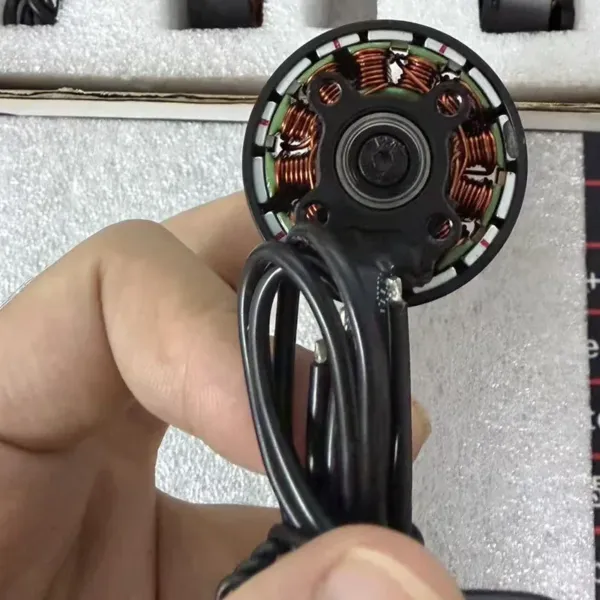
A gimbal motor is a brushless DC (BLDC) outrunner motor designed to hold a camera steady on a 2-axis or 3-axis gimbal. Unlike a propulsion motor, it runs at low speed and high torque, constantly micro-correcting against vibration and movement. That is why gimbal motors are wound with low KV (25–130 KV equivalent in these Yadovex models) — low KV means high torque per volt, which is exactly what stabilization needs.
Key defining features of a true gimbal motor:
- Outrunner construction — the outer can spins, giving high torque without a gearbox.
- Low KV, high pole count — smooth, jitter-free holding at any angle.
- Hollow shaft option — lets wiring pass through the axis for clean cable routing.
- Sensored or slip-ring versions — hall sensors and slip rings for precise, twist-free 360° pan control.
Gimbal Motor Specs Comparison: 4 Yadovex Models
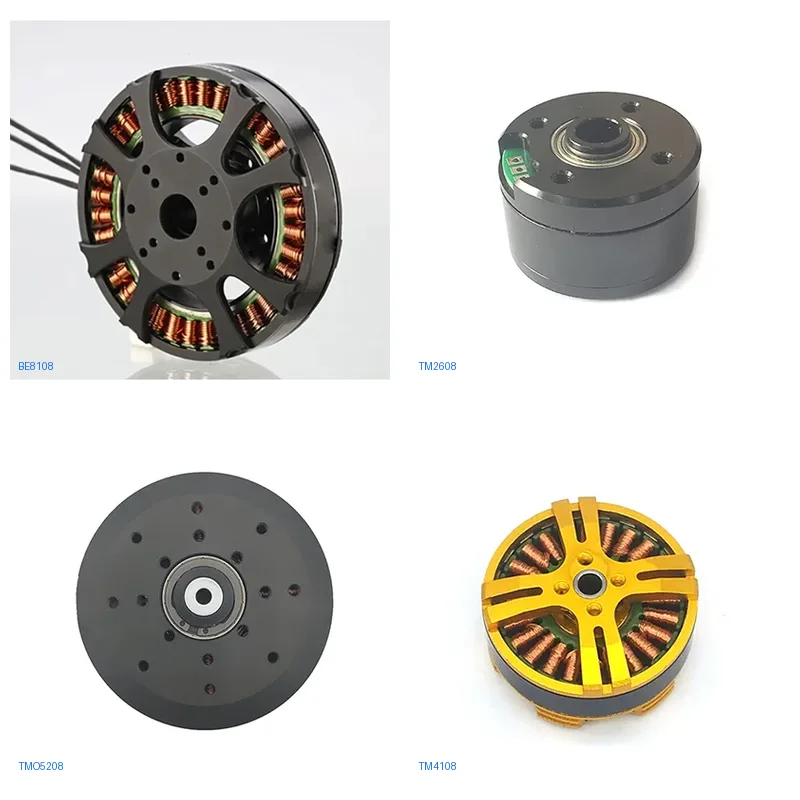
These are the four gimbal motors currently available from Yadovex, with the specifications we publish on each product page:
| Model | Stator size | Shaft | Torque | Weight |
|---|---|---|---|---|
| TM2608 70T | 2608 (32 × 20.5 mm) | 8.5 mm hollow | 420 g @ 5 V / 0.8 A | light |
| TM4108 130T | 4108 (46 × 25 mm) | 5.0 mm hollow | 700 g @ 5 V / 0.43 A | 93 g |
| TMO5208 | 5208 (63 mm OD × 24.5 mm) | 12.6 mm inner bore | 0.368 N·m / V @ 3S | 198.3 g |
| BE8108 | 8108 (86.8 × 26.6 mm) | 8.0 mm | 100 KV: 8.6 A / 215 W | 240 g |
Two of these — the TM2608 70T and TM4108 130T — are hollow-shaft action-camera gimbal motors. The TMO5208 is a sensored slip-ring motor for high-end DSLR work, and the BE8108 8108 100KV is the heavy-lift end of the family, equally at home on multirotor camera rigs.
How to Match a Gimbal Motor to Your Camera
The fastest way to choose is by the camera the gimbal has to carry. Over-spec adds weight and cost; under-spec makes the gimbal sag or hunt. Use this practical table:
| Camera class | Typical weight | Recommended motor |
|---|---|---|
| GoPro / action camera | 150–300 g | TM2608 or TM4108 |
| Mirrorless (Sony A7 / similar) | 500–900 g | TMO5208 (sensored + slip-ring) |
| DSLR / cinema rig | 900 g – 2 kg | TMO5208 or BE8108 |
| Heavy multirotor / payload platform | 2 kg + | BE8108 (100/135 KV) |
A useful rule of thumb: pick a motor whose published holding torque is at least 1.5× the total weight it has to lift (camera + gimbal frame). The TM4108’s 700 g rating covers a GoPro-class build with margin; the TMO5208’s sensored control handles the heavier, higher-moment DSLR rigs where smooth low-speed response matters more than raw torque.
Hollow Shaft vs Solid Shaft: Why It Matters for Wiring
A hollow-shaft gimbal motor lets you run camera video cables and servo/signal wires straight through the motor axis. On a rotating gimbal, that is a real advantage:
- No cable tangling during pan and tilt — wires don’t wrap around the axis.
- Lower rotating mass around the camera — easier to balance, less inertia for the controller to fight.
- Cleaner, more reliable builds — fewer exposed cables to snag or fatigue.
Yadovex’s TM2608 (8.5 mm hollow) and TM4108 (5.0 mm hollow) are both hollow-shaft models for this reason. The TMO5208 takes a different route to the same goal — a built-in slip-ring that carries power and signal across the rotating axis, so 360° pan moves never twist the wiring.
Sensored, Slip-Ring, and High-Torque Options for Professional Gimbals
If you are building a professional 3-axis gimbal for a DSLR or cinema camera, look beyond the basic outrunner. The TMO5208 combines two features you cannot get from a generic motor:
- Hall sensors give precise rotor position feedback for silky low-speed control — exactly what a professional gimbal controller needs for smooth pans.
- Slip ring transfers power and signal across the rotating axis, eliminating cable twisting on continuous 360° rotation.
At the heavy end, the BE8108 8108 100KV is built around a 36N42P stator and an 86.8 mm frame. Its 100 KV wind carries 8.6 A continuous / 215 W, and the 135 KV wind ups that to 16.3 A / 407 W — enough for large cinematic gimbal rigs and survey platforms on 6S–12S packs.
What Factory Quality Looks Like (and What to Ask a Supplier)
Two motors with the same model number can behave very differently depending on the factory that made them. What actually separates a good gimbal motor from a cheap one:
- Magnet grade and copper fill — higher-grade N48–N52 magnets and denser copper windings give more torque per gram and lower heating.
- KV consistency — a ±5% KV tolerance means predictable, repeatable behavior across a batch; ±10% means your gimbal tunes differently on every unit.
- Bearings and shaft runout — a low-vibration bearing set and tight runout are what keep jitter out of your footage.
- Per-unit testing — ask whether the factory measures KV, no-load current, and resistance on every motor or only spot-checks samples.
Questions worth asking any gimbal motor supplier before you order:
- What is your KV tolerance across a production batch?
- Do you measure no-load current and resistance per unit or per batch?
- Can you supply hollow-shaft, custom shaft length, wire length, and connector options for OEM/ODM?
- What magnet grade and stator lamination are used in this model?
- Can you share thrust or torque test data for this exact wind?
As a China-based manufacturer, Yadovex publishes the specifications above directly on each product page, and every model in this guide is available with custom shaft, wire, and connector options — samples first, then repeat bulk shipments. If you tell us your camera and gimbal setup, we can recommend the specific wind and shaft configuration.
Final Verdict
For a GoPro-class aerial photography gimbal, choose the TM4108 130T — 93 g weight, 700 g holding torque, and a 5.0 mm hollow shaft give you the best balance of torque and weight. For a mirrorless or DSLR rig where smooth 360° pan matters, the TMO5208 sensored slip-ring motor is the professional pick. And if you are building a heavy payload platform or large cinematic rig, the BE8108 8108 100KV has the torque and power headroom you need.
Need help matching a gimbal motor to your build? Contact Yadovex with your camera model and gimbal setup — we will recommend the right motor, wind, and shaft configuration, and can send samples for validation before you commit to bulk.
FAQ
What is a gimbal motor used for?
A gimbal motor is used to hold a camera steady on a 2-axis or 3-axis camera gimbal, constantly micro-correcting to cancel out vibration and movement from the drone or handheld rig.
How do I choose a gimbal motor for my drone?
Match the motor to your camera class and weight. GoPro-class builds suit a 2608 or 4108 hollow-shaft motor, mirrorless/DSLR rigs need a larger sensored motor like the 5208, and heavy payload platforms need a high-torque motor such as the 8108.
What does KV mean on a gimbal motor?
KV is the motor speed per volt with no load. Gimbal motors use low KV (roughly 25–130 in Yadovex’s range) because low KV means high torque per volt — exactly what slow, precise camera stabilization requires.
Why do gimbal motors have hollow shafts?
A hollow shaft lets camera video cables and signal wires route straight through the motor axis, preventing tangling during pan and tilt and reducing rotating mass around the camera.
What is a slip-ring gimbal motor?
A slip-ring gimbal motor carries power and signal across the rotating axis through a slip ring, so continuous 360° pan moves never twist or fatigue the wiring — ideal for professional DSLR and cinema gimbals.
What is the difference between a sensored and sensorless gimbal motor?
A sensored gimbal motor uses hall sensors for precise rotor position feedback, giving smoother low-speed control that a professional gimbal controller needs. Sensorless motors rely on back-EMF and can be less smooth at very low speeds.

Hallen Liu is a product and sourcing specialist at Yadovex, a China-based supplier of FPV and UAV brushless motors, servos and propellers. He works directly with drone builders, distributors and OEM buyers on motor selection, thrust-test data, custom KV and OEM/ODM orders — from sample validation through repeat bulk shipments.