
How Outrunner Motors Are Made: Rotor Bells, Magnets and the Quality Checklist Buyers Need
An outrunner motor is a brushless motor whose outer shell rotates around a fixed stator, and for FPV, long-range and heavy-lift drones it delivers more torque per gram than an inrunner of the same size — which is why almost every drone motor is an outrunner. This guide explains how outrunner motors work, how they are made, and the factory-level checks that separate a motor that lasts 500 flights from one that fails in 20.
Quick answer
- Outrunners spin the outer shell (rotor bell); inrunners spin an inner shaft.
- High torque at low RPM without a gearbox — ideal for spinning drone propellers directly.
- Core parts: rotor bell, magnets, stator, copper windings, bearings and shaft.
- Quality hides in magnet grade, lamination thickness, winding fill and dynamic balancing.
- Per-unit testing is what makes a batch consistent — and consistency is what buyers need.
What Is an Outrunner Motor?
An outrunner motor is a brushless DC motor in which the outer housing — the rotor bell — rotates around a fixed inner stator. The stator holds the copper windings, and the rotating bell carries the permanent magnets. As current flows through the windings in sequence, the magnetic field drags the bell around with it, turning the shaft machined into the bell. This is the opposite of an inrunner, where the shaft spins inside a fixed outer case. For a full side-by-side comparison, see Outrunner vs Inrunner Brushless Motors: Which One Do You Need?
| Part | Function | Typical material |
|---|---|---|
| Rotor bell (housing) | Rotates, carries the magnets, acts as a cooling fan | Aluminum alloy, CNC-machined |
| End cap | Closes the bell, holds the shaft, vents heat | Aluminum, often with spoke cutouts |
| Shaft | Mounts the propeller, transfers torque | Hardened steel, threaded or D-cut |
| Magnets | Create the rotating magnetic field | Sintered N45/N52 rare-earth |
| Stator + windings | Generate the field that drags the bell around | Silicon-steel laminations + enameled copper |
| Bearings | Keep the shaft spinning smoothly under load | Steel or hybrid ceramic |
Why Drones Use Outrunners Instead of Inrunners
Multirotor propellers need high torque at relatively low RPM, and outrunners provide exactly that without a reduction gearbox. A gearbox adds weight, noise, maintenance and failure points — none of which you want on a drone frame. Because the heavy part (the bell) is on the outside, outrunners also shed heat well: the spinning shell acts as a fan. That is why 6S long-range builds, cinematic rigs and heavy-lift platforms all run outrunners.
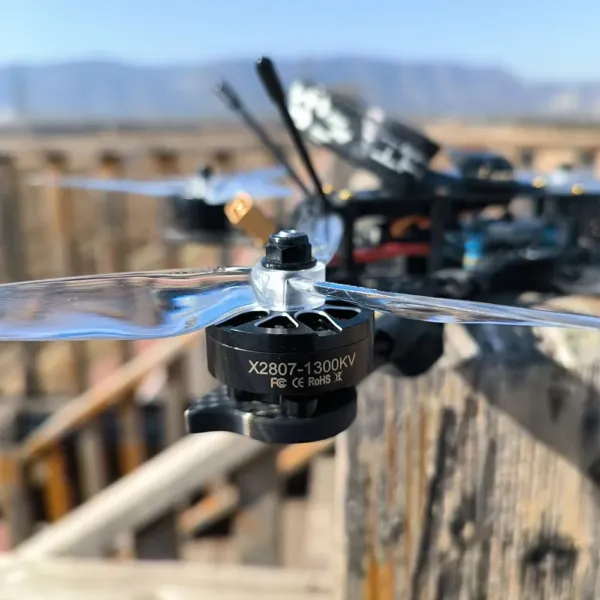
What the Rotor Bell Looks Like — a Real 2807 Motor
The rotor bell is the heart of an outrunner: it is the part you see spinning, it carries the magnets, and its end cap is usually machined with spoke cutouts that reduce weight and vent heat. The threaded shaft in the center is what your propeller mounts on.
This video shows a Yadovex 2807 outrunner motor rotating, filmed all the way around so you can see the bell, the end cap cutouts and the shaft clearly:
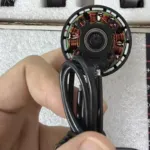
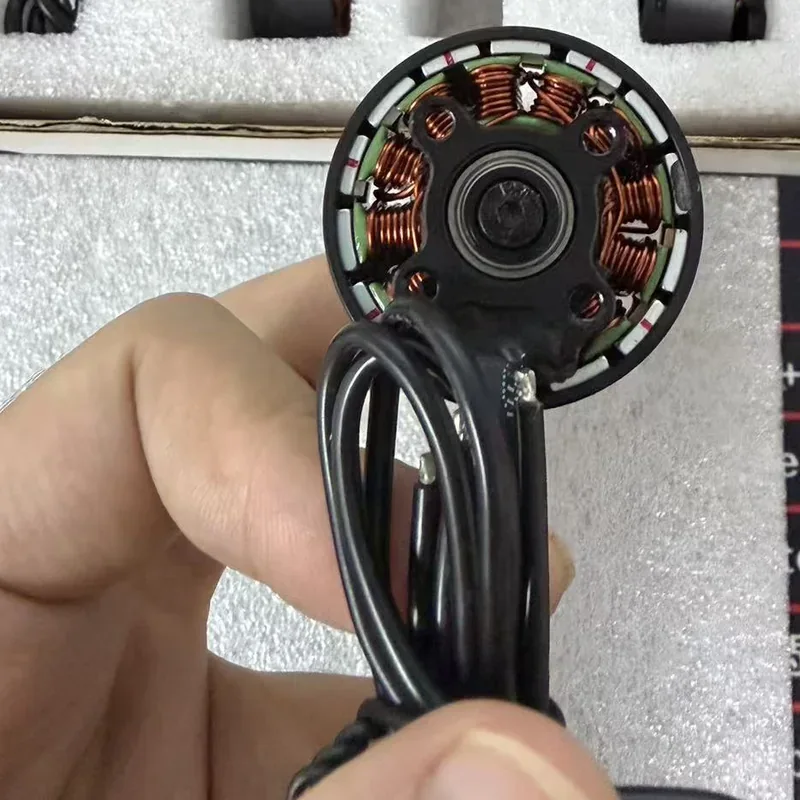
And here is the same motor seen from the stator side. The copper windings, the center bearing and the mounting holes are what you actually check when a motor arrives — they tell you a lot about build quality before you ever fly it:
How an Outrunner Motor Is Made, Step by Step
The manufacturing sequence matters because every step leaves a trace in performance and lifespan:
- Stator lamination stamping — thin silicon-steel sheets are stamped and stacked. Thinner laminations (0.20 mm vs 0.35 mm) mean lower eddy-current losses and cooler running.
- Winding — enameled copper wire is wound onto the stator teeth. A high slot fill rate packs more copper in the same space, lowering resistance and raising efficiency.
- Rotor bell machining — the bell, end cap and shaft are CNC-machined, then the end cap is fitted to the bell.
- Magnet mounting — arc magnets are glued into the bell. Magnet grade (N45 vs N52) and the consistency of the air gap decide how much torque the motor can produce.
- Shaft and bearings — the shaft is pressed in and bearings seated with the correct preload. Bearing quality shows up first as vibration and noise after a few dozen flights.
- Dynamic balancing — each rotor is spun and balanced so it runs without high-frequency vibration at speed.
- Assembly and QC — stator, bell, bearings and wires are assembled, then each unit is tested for KV, current draw and smooth rotation.
Rotor Bells at Batch Scale: Inside the Factory
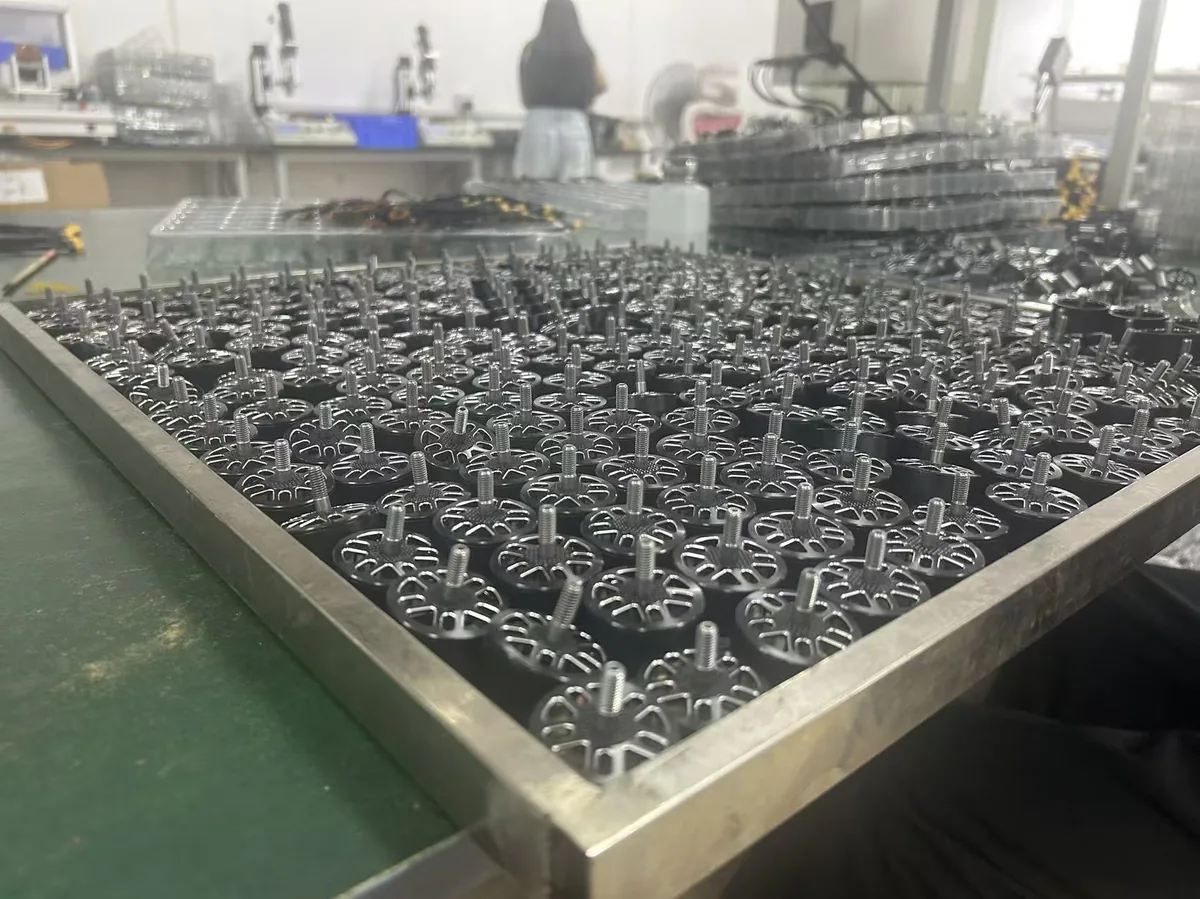
The rotor bell is machined, magnet-filled, balanced and tested in large batches, and batch consistency is the whole game. Below is a close-up of outrunner rotor bells at the Yadovex factory: aluminum end caps with cutout spokes, threaded steel shafts, and the magnet housings waiting to be filled.
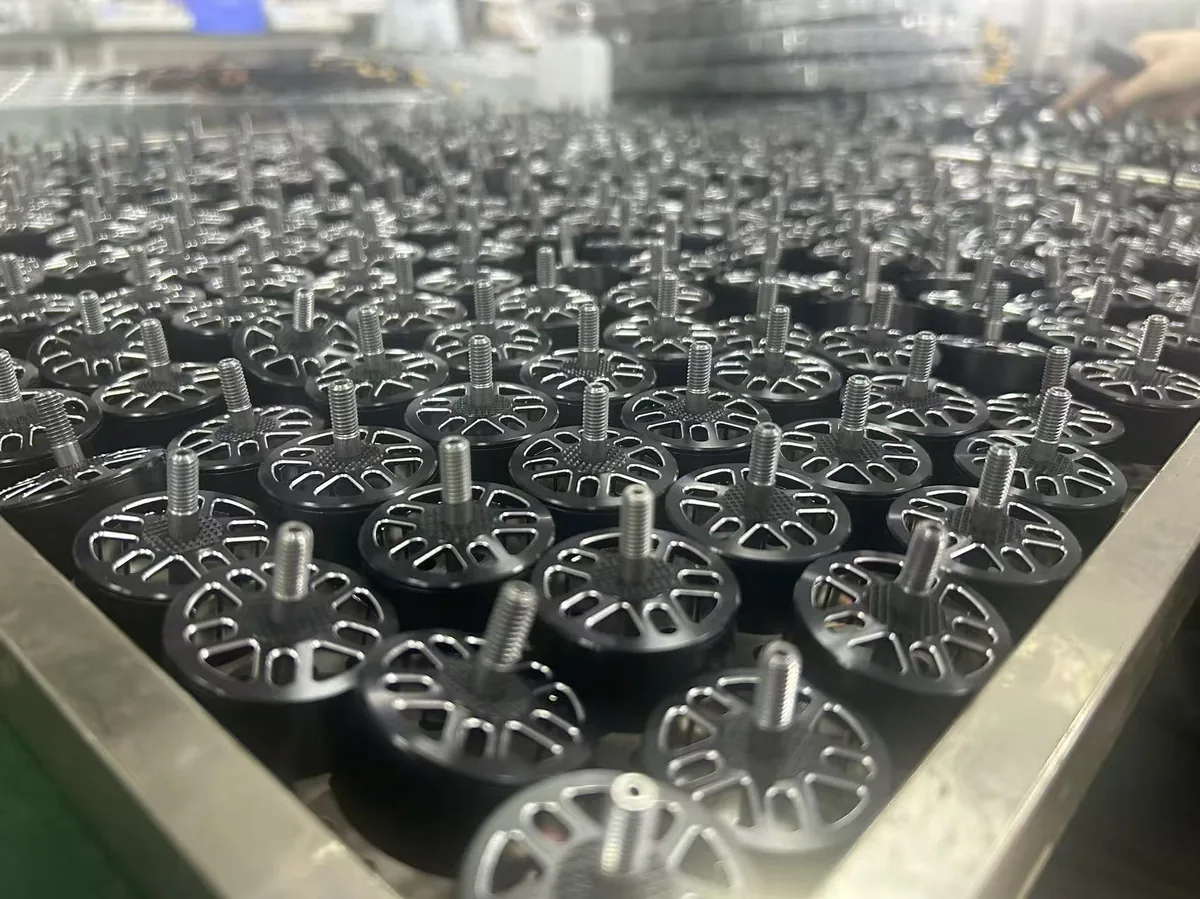
The second photo shows the same batch on the production line — hundreds of rotor bells per tray, row after row. This scale matters less than the fact that every unit in the tray is the same: same magnet seating, same balancing, same KV.
Where Quality Hides: Same KV, Very Different Lifespan
Two outrunner motors with the same size and KV can perform completely differently in the air. The difference is never on the label — it is in five places:
| Checkpoint | What to verify | Why it matters |
|---|---|---|
| Magnet grade | N45 vs N52, and magnet count | Higher grade = more torque; cheap magnets demagnetize when hot |
| Stator lamination | 0.35 mm vs 0.20 mm sheets | Thinner = less heat, better efficiency at partial throttle |
| Winding fill | Slot fill rate, wire quality | More copper = lower resistance = cooler and more efficient |
| Bearings | Brand, clearance, preload | Bad bearings show up as vibration and noise after 20–50 flights |
| Balancing | Dynamic balancing per unit | Unbalanced rotors vibrate, which kills bearings and flight controllers |
KV tolerance is another tell: a factory that holds KV within ±5% per unit is testing every motor; one that ships ±10% batches is only sampling.
5 Questions to Ask Your Motor Supplier Before Ordering
- Do you test KV on every unit or on a sample? Ask for the test record from the last batch.
- What magnet grade do you use, and what is the continuous-power temperature limit?
- What is your KV tolerance, and what does a unit outside tolerance get you?
- What bearings do you use, and are they available as spares for your customers?
- Can I get a sample built exactly like the bulk order? Sample approval should match mass production.
How to Check Motor Quality When the Batch Arrives
You do not need a lab to catch the worst failures. Spin each motor by hand: it should rotate smoothly with no gritty feel. Measure KV on a sample — it should sit inside the promised tolerance. Run the motor on the bench for a few minutes and feel the bell: even heating across the housing means winding and magnets are uniform; a hot spot means something is off. Finally, listen: a consistent whine with no rattling is the sound of a balanced rotor.
Frequently Asked Questions
What is an outrunner motor?
An outrunner motor is a brushless DC motor whose outer shell rotates around a fixed stator. The rotating shell carries the magnets and doubles as the cooling surface, which is why most drone motors are outrunners.
Why are outrunner motors used in drones?
They produce high torque at low RPM directly, without a gearbox. That means lighter, simpler and more reliable propulsion for multirotor propellers.
What is the rotor bell in a brushless motor?
The rotor bell is the rotating outer housing of an outrunner motor. It holds the magnets, carries the shaft, and its end cap usually has cooling cutouts.
Are outrunner motors more powerful than inrunners?
For the same diameter, outrunners deliver more torque at low RPM, which suits propellers. Inrunners favor high-speed, gear-driven applications.
How do I know if an outrunner motor is good quality?
Check KV tolerance, magnet grade, lamination thickness, bearing brand and dynamic balancing. Test samples for smooth rotation, even heating and consistent KV.
Can I order custom outrunner motors from the factory?
Yes. Yadovex supports custom KV, shaft, wire length and connector options for OEM and ODM orders, from sample validation to repeat bulk shipments.
Where can I buy outrunner motors wholesale or OEM?
You can order outrunner motors wholesale directly from Yadovex, a China-based motor manufacturer. We support OEM and ODM projects: custom KV, shaft, wire length, connectors and packaging, from sample validation to repeat bulk shipments with consistent quality control.
Final Verdict
Buy from a supplier that tests every unit, publishes tolerances and lets you approve a sample built exactly like the bulk order. Ask every factory for the kind of evidence shown above: your parts, on their line, at batch scale. If a supplier cannot show you that, treat the price difference as risk, not savings.
Need help choosing an outrunner for your build? Yadovex supplies outrunner motors from 28 mm FPV sizes up to 86 mm heavy-lift platforms, with custom KV and OEM options. Contact us with your frame, propeller and target thrust and we will recommend a motor — or message us on WhatsApp.

Hallen Liu is a product and sourcing specialist at Yadovex, a China-based supplier of FPV and UAV brushless motors, servos and propellers. He works directly with drone builders, distributors and OEM buyers on motor selection, thrust-test data, custom KV and OEM/ODM orders — from sample validation through repeat bulk shipments.