
7-Inch vs 9-Inch Long-Range Drone Motors: Which Do You Need?
Short answer: choose a 7-inch long-range build if you want agility, low weight and a take-off weight near 1 kg; choose 9-inch if you need to carry a real payload, hold position in stronger wind, or run a bigger battery for longer endurance. The 7-inch class runs 1300–1700KV on 6S with a 28 mm-class stator and a 7×3.5×3 propeller; the 9-inch class steps down to 900–1050KV on a 31×12-class stator with a 9×5×3 prop.
Quick answer
- 7-inch: 2807-class stator (Φ28.0 × 7.0 mm, 56 g) · 1300KV on 4–6S · 7×3.5 or 7×4 prop · 45–60 A ESC
- 9–10 inch: 3115-class stator (Φ37.5 mm body, 107 g) · 900KV on 6S · 10×4.5 or 10×5 prop · 60–65 A ESC · 4.6–5.2 kg thrust per axis
- Do not size the motor by KV. KV is a winding ratio; stator volume, magnet grade and KV tolerance decide what the motor can actually hold in the air.
- Pick the propeller first, then the stator size, and only then the KV for your cell count.
1. What actually changes when you move from 7-inch to 9-inch
A motor model number describes the stator: a 2807 has a 28 mm stator diameter and a 7 mm stack; a 3112 has a 31 mm diameter and a 12 mm stack. More stator volume gives you more torque per amp and more surface area to shed heat, which is exactly what lets a bigger propeller be spun without the windings cooking.
The cost is weight, and weight is the variable that decides endurance. A 7-inch long-range quad can realistically land around 800 g–1.2 kg all-up; the same electronics on a 9-inch frame with a 9-inch propeller set and a larger pack usually climbs to 1.6–2.5 kg. Since hover power rises roughly with weight to the power of 1.5, the heavier aircraft has to carry its own penalty in every minute of flight.

2. The motor classes, with real numbers
Below are the actual stator sizes and published specifications from our own catalogue, so you can map a propeller size to a motor without guessing:
| Motor | Stator | Typical propellers | Class |
|---|---|---|---|
| 2807 1300KV | Φ28.0 × 7.0 mm | 6–7 inch (7×3.5 / 7×4 on 4–6S) | Long range / freestyle |
| 2812 900KV | Φ28.0 × 12.0 mm | 6–7 inch | Long range |
| 3110 900KV | Φ31.0 × 10.0 mm | 7–8 inch | Long range / cinematic |
| 3112 900KV | Φ31.0 × 12.0 mm | 7–9 inch | The 9-inch long-range choice |
| 3115 900KV | Φ37.5 × 30 mm body | 9–10 inch (best 10×4.5 / 10×5) | The 9–10 inch long-range choice |

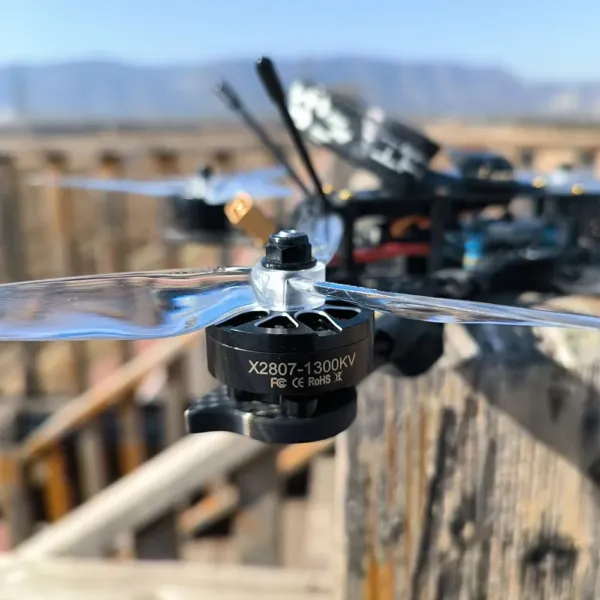
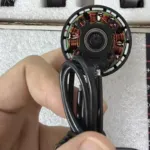
Left: 2807 1300KV (7-inch class, 56 g). Right: 3115 900KV (9–10 inch class, 107 g).
Read that table carefully, because it is the part most “7 vs 9” articles get wrong. The 2807 is a 6–7 inch stator in its 1300KV wind (the same stator covers 8–9 inch when wound to 900–1100KV); the 3110 covers 7–8 inch; the 3112 covers 7–9 inch; and the 3115 is the motor that genuinely carries a 9–10 inch propeller — 107 g, 6S, 60–65 A ESC, 4.6–5.2 kg of thrust per axis. Note that 900KV + 6S above a 10.5-inch propeller pushes tip speed into the efficiency cliff, so 10 inch is the practical ceiling for this class.
3. Thrust, current and efficiency at cruise
Full-throttle thrust sells motors; cruise efficiency flies them. A long-range aircraft spends most of its time between 40% and 60% throttle, so the numbers that matter are current and g/W in that band, not the peak figure on the box.
The table below is measured thrust-stand data from one of our own runs — a 3115 900KV with an HQProp 10×5×3 on 6S:
| Throttle | Voltage (V) | Current (A) | RPM | Thrust (kg) | Input power (W) | Efficiency (g/W) |
|---|---|---|---|---|---|---|
| 30% | 22.25 | 0.86 | 2,999.6 | 0.13 | 8.7 | 15.34 |
| 40% | 22.12 | 2.66 | 4,860.5 | 0.39 | 35.8 | 10.95 |
| 50% | 21.82 | 6.64 | 6,815.3 | 0.83 | 100.9 | 8.20 |
| 60% | 21.32 | 13.14 | 8,621.2 | 1.36 | 205.7 | 6.61 |
| 70% | 20.63 | 22.47 | 10,200.2 | 1.95 | 346.4 | 5.63 |
| 80% | 19.80 | 33.48 | 11,444.3 | 2.49 | 494.2 | 5.04 |
| 90% | 18.91 | 45.37 | 12,386.4 | 2.93 | 634.0 | 4.62 |
| 100% | 18.72 | 47.87 | 12,554.1 | 3.01 | 659.9 | 4.56 |
Measured on our thrust stand at 6S with the motor-propeller pair stated above. Efficiency (g/W) = thrust ÷ input power, so it falls as current rises: the same motor is more than three times as efficient at 30% throttle as it is at full throttle. That is the whole argument for building light and cruising low.
The comparison table below puts the two classes side by side at the same throttle points. The 9–10 inch row is measured data from the same run as the table above; the 7-inch row is a class reference value — confirm it against the datasheet for your exact motor, propeller and pack:
| Setup (6S) | Throttle | Current (A) | Thrust (kg) | Efficiency (g/W) |
|---|---|---|---|---|
| 2807 1300KV 7×3.5×3 |
50% | 5.5 | 0.72 | 6.0 |
| 100% | 42.0 | 2.40 | 3.0 | |
| 3115 900KV 10×5×3 (measured) |
50% | 6.64 | 0.83 | 8.20 |
| 100% | 47.87 | 3.01 | 4.56 |
If you want the fundamentals first — how KV, stator size and thrust curves fit together — read How to Choose FPV Drone Motors for 6S Long-Range Drones.
Two things fall out of that comparison. First, the 9-inch setup produces roughly 45% more thrust at the same 50% throttle — that is the payload and wind margin you are buying. Second, it is also more efficient in g/W, because a larger disc accelerates a bigger mass of air more slowly. The 9-inch build wins on aerodynamics and loses on mass; whether it wins the flight-time contest depends entirely on how much of that thrust you actually need.
3. KV, RPM and propeller matching
No-load RPM is simply KV × pack voltage. On 6S (22.2 V nominal, 25.2 V charged):
- 2807 1300KV → about 28,900 RPM no-load → a 7-inch propeller reaches a safe, efficient loaded RPM
- 3112 900KV → about 20,000 RPM no-load → correct for a 9-inch propeller
- 3110 900KV → about 20,000 RPM no-load → comfortable at 7–8 inch
Put a 7-inch motor on a 9-inch propeller and you over-prop it: current and temperature rise sharply and the ESC can desync under fast throttle changes. Put a 9-inch motor on a 7-inch propeller and you carry extra stator mass for thrust you never use. Choose the propeller, then the stator, then the KV.

4. ESC, battery and the weight budget
- ESC: size it above the highest current in your thrust table, not above the motor’s label. A 7-inch 6S build on 7×3.5×3 typically lands around 40–45 A peak, so a 45–60 A 4-in-1 has margin; the 9-inch setup runs into the high 40s, so plan on 60–65 A.
- Battery: 6S 1100–2200 mAh for most 7-inch cruisers; 6S 2200–4200 mAh once you move to 9-inch. Remember that a bigger pack adds mass, and hover power scales faster than capacity, so the endurance curve flattens quickly.
- Mount pattern: check hole spacing and shaft diameter before ordering. The most common “the motor does not fit” support question is a 16×19 mm versus 19×25 mm mount pattern mismatch, not a performance problem.
- Wiring: at these currents, cable gauge and connector choice matter as much as FET quality. Thin leads and a tired XT30 will cost you more thrust than any KV choice.
5. The part most comparisons never mention
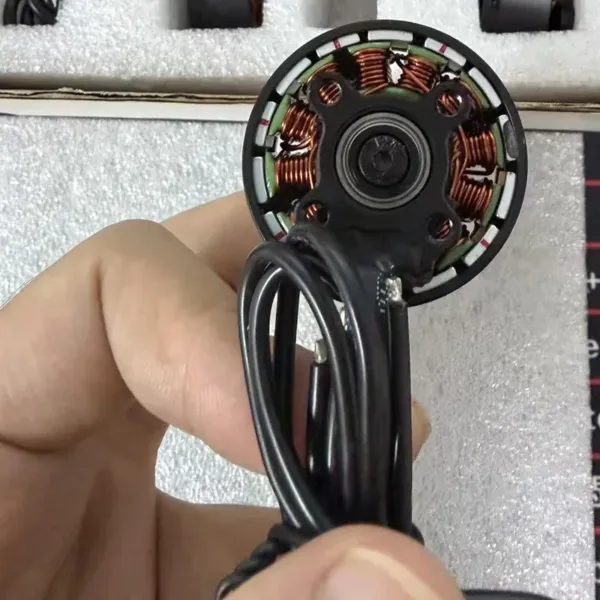
Two motors labelled 3112 900KV are not the same motor. KV describes the winding ratio only — it says nothing about how the motor is built, and the differences show up directly in the numbers above:
| What varies | Cheap build | What a good build specifies | What you feel in flight |
|---|---|---|---|
| Magnet grade | Standard N45 | N45SH or better | Torque per amp, and whether thrust fades as the bell heats up |
| Stator laminations | 0.35 mm | 0.15–0.20 mm silicon steel | Lower eddy-current loss — visible as g/W at cruise |
| Bearings | Unbranded, loose play | branded (NSK / NMB) bearings | Vibration, bearing noise and service life |
| Winding insulation | 130 °C class | 180 °C rated wire | Whether a hot summer flight shortens the motor’s life |
| KV tolerance | ±10% between batches | Measured per unit | Whether your four motors actually match each other |
The KV tolerance line is the quiet one. Four motors sold as 900KV can sit anywhere between roughly 810KV and 990KV, and the difference shows up as a quad that drifts or drops a corner under hard throttle — a fault that no amount of PID tuning removes. If a supplier cannot tell you the measured per-unit KV spread of the batch they are shipping you, they are not testing their own output.
Five questions worth asking before you order a 9-inch propulsion set:
- What magnet grade is used, and what is the maximum operating temperature?
- What is the measured KV tolerance per unit, not per batch?
- What stator lamination thickness is used?
- Which bearing brand and radial play?
- Can you send thrust, current and temperature data for this exact motor and propeller combination?
Watch: our production floor at night
This is the workshop late in the evening – the line still running and the team on overtime to clear outstanding orders. Capacity is the easiest thing for a supplier to claim and the hardest to verify from a catalogue, so here is ours outside normal hours. If you are placing an OEM order against a fixed launch date, ask for footage like this: it tells you more about your lead time than any promise does.

Night shift on the Yadovex production floor – watch on YouTube.
6. Which one should you buy?
Choose 7-inch if:
- This is your first long-range build, or you fly in tighter spaces
- You want the lightest possible aircraft for travel or cinematic work
- Your payload is an action camera or a small gimbal
- You want a lower cost per crash and easier transport
Choose 9-inch if:
- You need to lift a real payload — mapping, inspection, delivery, spray-adjacent work
- You fly in strong wind or need to hold a long, straight line
- You want more endurance from a larger pack at the same payload
- Your frame is designed for 9–10 inch propellers, and you accept the extra mass
If your requirement sits between the two, the 3110 900KV on a 7–8 inch propeller is the honest middle: it takes a 7-inch frame up to an 8-inch disc without the mass penalty of a 9-inch set-up. You can browse the whole range in our Long Range FPV Motors category.
The 2807 stator is also offered in other winds: 2807 1500KV (6–7 inch), 2807 1700KV (5–6 inch cinewhoop) and 2807 900KV (8–9 inch long range). The 2807 1300KV remains the stocked version for 6–7 inch 6S builds.
7. Frequently asked questions
Is a 9-inch drone always better for long range than a 7-inch?
No. Range comes from efficiency and mass, not from diameter. A light, well-built 7-inch cruiser will outfly a heavy 9-inch aircraft carrying the same payload. Choose 9-inch when you need payload capacity or wind resistance.
What KV should a 6S 9-inch long-range motor be?
900–1050KV. A 900KV motor on 6S turns about 20,000 RPM no-load, which suits a 9×5×3 propeller without pulling excessive current. Our 3112 900KV covers 7–9 inch propellers for exactly this reason.
Can I use a 2807 motor on a 9-inch frame?
It will physically mount on many frames, but a 28 × 7 mm stator does not have the torque or heat capacity for a 9-inch propeller. Expect high current, high winding temperature and possible ESC desync. Step up to a 31×12-class stator such as the 3112.
What is the real weight difference between the two classes?
The 2807 1300KV in the 7-inch class weighs 56 g, and the 3115 900KV in the 9–10 inch class weighs 107 g — about 50 g more per motor, or roughly 200 g across a quad, before you add the larger propellers and pack.
Do you provide thrust test data for a specific motor and propeller combination?
Yes. Tell us your cell count, propeller and target payload, and we will send the thrust, current and efficiency data for that exact combination. The measured table above is an example of what you receive.
Compare the classes directly: drone motors | long-range FPV motors | cinelifters and heavy-lift motors.
Final verdict
Build 7-inch if the aircraft needs to stay light and you mostly shoot or cruise: a 2807 1300KV on a 7×3.5×3 propeller with a 45–60 A ESC and a 6S 1100–2200 mAh pack. Build 9-inch when payload and wind margin matter more than grams: a 3115 900KV on a 10×4.5 or 10×5 prop with a 60–65 A ESC and a 6S 2200–4200 mAh pack (the 3112 900KV is the right pick if your frame tops out at 9 inch). Either way, size the ESC from the thrust table, not the label, and ask for the per-unit KV spread before you buy a set of four.
Not sure which class fits your airframe? Send us your frame size, target take-off weight and flight time and we will propose a stator and KV combination — then send the measured data for that exact setup. Contact our team or message us on WhatsApp.

Hallen Liu is a product and sourcing specialist at Yadovex, a China-based supplier of FPV and UAV brushless motors, servos and propellers. He works directly with drone builders, distributors and OEM buyers on motor selection, thrust-test data, custom KV and OEM/ODM orders — from sample validation through repeat bulk shipments.