

How to Choose a High-Torque Servo: 20kg vs 25kg vs 30kg Digital Servos
To choose a high-torque servo, take the torque your application needs and multiply it by a safety factor of 2 — if a robot arm joint needs about 10 kg·cm of holding torque, you need at least a 20kg servo, and for continuous or fast movement, size up to 25kg or 30kg. This guide compares 20kg, 25kg and 30kg digital servos, explains what torque numbers really mean, and shows you the internal build quality that decides whether a servo lasts or burns out.
Quick answer
- 20kg: light robot arms, pan-tilt mechanisms, small RC crawlers
- 25kg: mid-size robot arms, RC cars and boats, camera gimbals
- 30kg and up: heavy robot joints, large RC crawlers, sailboats, industrial prototypes
- Match servo voltage (4.8–7.4V) to your BEC; torque scales with voltage
- Buy metal-gear servos for anything beyond light hobby use — plastic gears strip under load
What Does “20kg / 25kg / 30kg” on a Servo Mean?
The number on a servo is its stall torque in kilogram-centimeters (kg·cm): the maximum torque it can produce at 1 cm from the output shaft before it stalls. It is not the weight the servo can “lift” — it is a torque value measured at a fixed arm length. A 20kg servo produces 20 kg·cm of torque at a 1 cm arm, and proportionally less at a longer arm.
| Torque unit | 1 kg·cm equals | Used by |
|---|---|---|
| kg·cm | 1 | Common spec in Asia and RC markets |
| oz·in | 13.9 | Common spec in US market |
| N·m | 0.098 | Engineering / robotics spec |
| lb·in | 0.868 | US industrial spec |
These numbers are rated at a specific voltage. A servo that produces 25kg at 7.4V will produce noticeably less at 4.8V, so always compare torques at the same voltage — or at the voltage you actually run.
20kg vs 25kg vs 30kg: Which One Do You Need?
The right size depends on the load at the joint, the arm length, and whether the servo moves continuously or holds position:
| Servo | Typical torque need | Best for | Angle options |
|---|---|---|---|
| 20kg | Light joints, ≤15 cm arms | Pan-tilt, small robot arms, crawlers | 180° |
| 25kg | Mid joints, ≤20 cm arms | RC cars, boats, camera gimbals | 180° |
| 30kg+ | Heavy joints, long arms | Large robot arms, big crawlers, sailboats | 180° / 270° |
If you are building a robot arm, add up the torque needed at the farthest joint (the one carrying the most load) and multiply by 2 for safety. If you are upgrading an RC car or crawler, look at the steering force you want at the wheels — and remember waterproofing matters if you run in mud or water.
Need the waterproof option for boats, crawlers and outdoor robots? See our waterproof digital servos and brushless waterproof servos ranges.
Why the Gear Material Matters More Than the Torque Rating
Two servos can both claim “25kg” and perform completely differently after a month of use. The biggest difference is the gear train. A servo with metal gears survives repeated shock loads and high temperatures; a plastic-gear servo strips its first gear under a hard stall and is dead.
Here is what a high-precision metal gear set looks like inside a digital servo — note the steel output gear and the top and bottom bearings that keep the shaft stable under load:
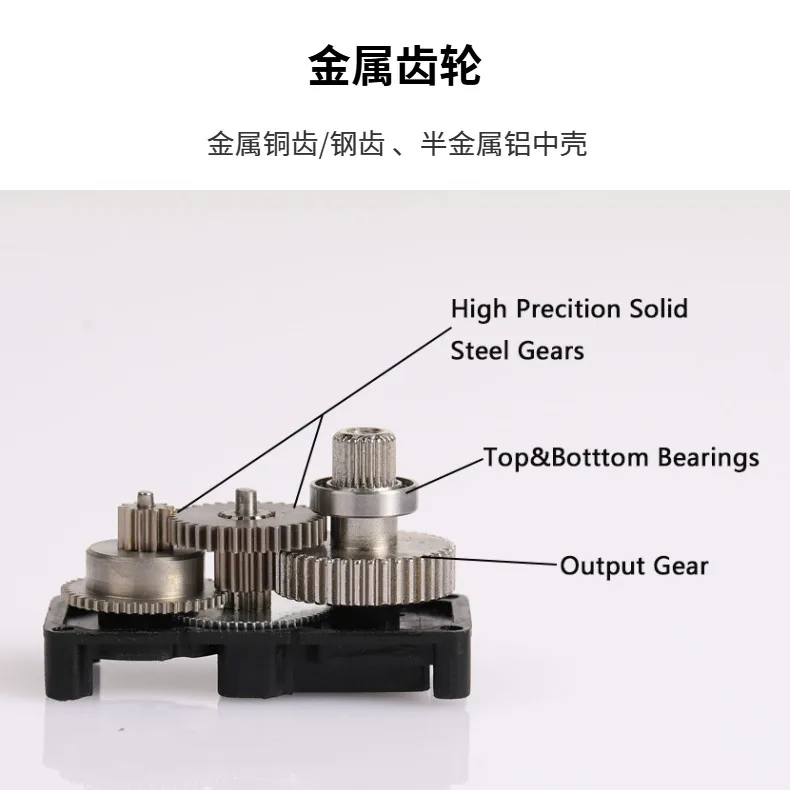
When a supplier writes “metal gear”, ask whether it is steel or brass, and whether the output gear (the one that takes the most abuse) is hardened steel. Cheap “metal” servos often use soft metal gears that wear out as fast as plastic.
The 35kg Model and Its Full Accessory Kit
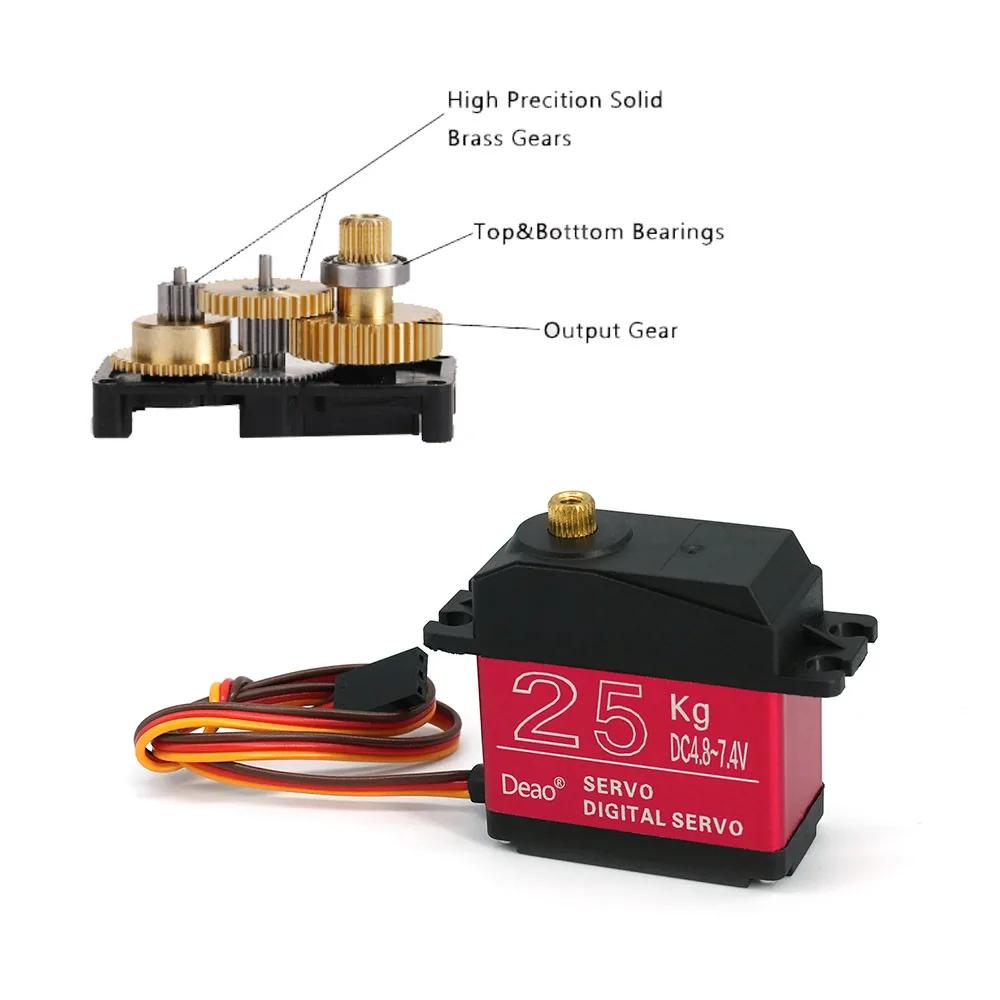
For heavier joints and larger RC cars, a 35kg digital servo gives more headroom. One practical advantage of buying a servo kit like this is the accessories: servo arms in different shapes, a mounting disk, rubber dampers, brass collars and screws — everything you need to fit it to a crawler or robot arm without hunting for parts.
25kg Servo and Its Gear Set Up Close
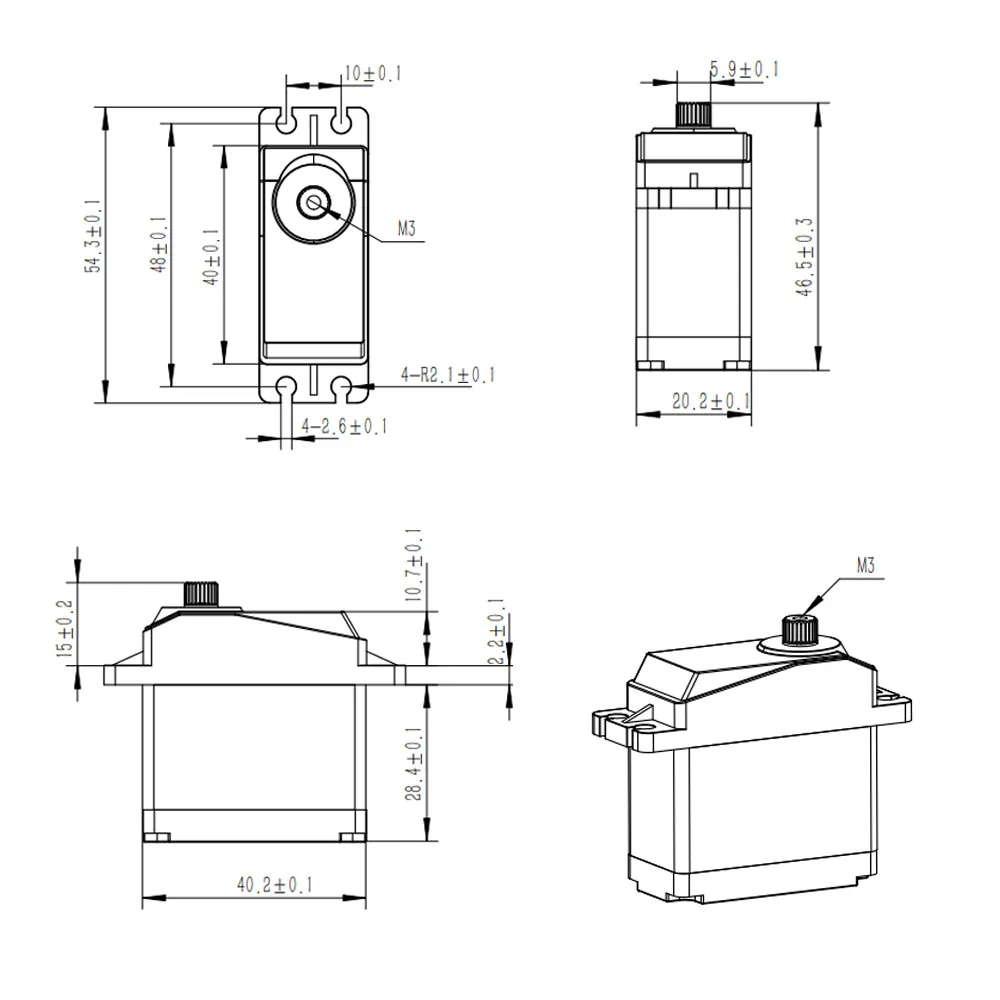
The 25kg class is the sweet spot for many builders: enough torque for mid-size projects without the weight and current draw of a 30kg unit. Here you can see the brass gear set next to the servo — brass gears are quieter and smoother than steel, at a small cost in absolute strength:
Watch: Digital Servos in Ready Stock
This video shows Yadovex digital servos in ready stock — the 20kg, 25kg, 30kg and 35kg high-torque models. Seeing the actual units helps you judge finish quality, connector style and case size before you order:
Check the Dimensions Before You Mount
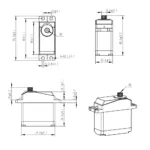
High-torque servos come in a few standard case sizes, but never assume yours fits — measure. A digital servo is typically around 40 × 20 × 40 mm, with M3 output shaft and four mounting holes on standard spacing. Here is the engineering drawing with the exact dimensions and tolerances:
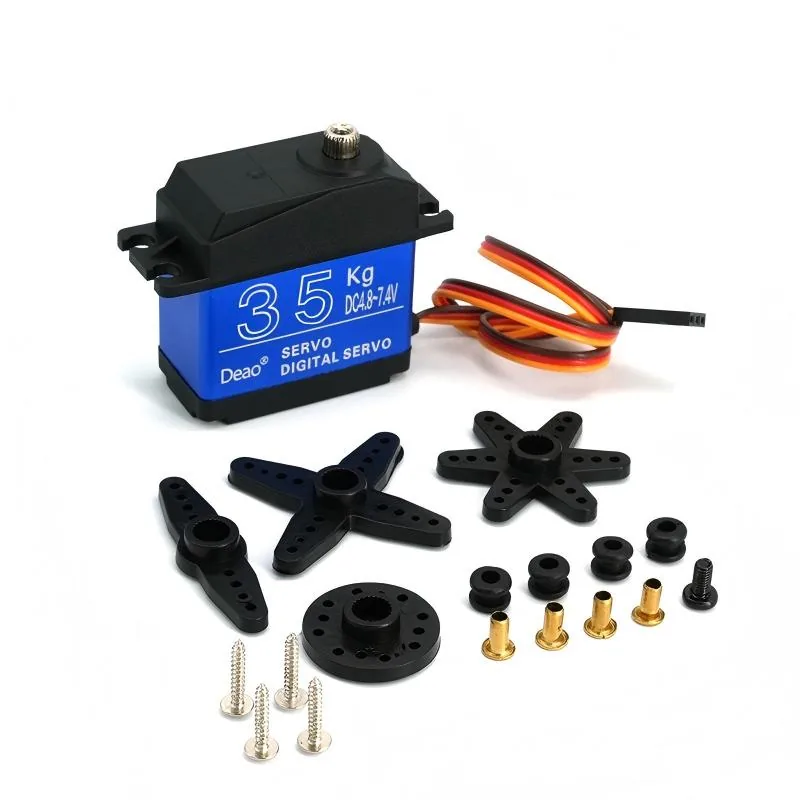
If your servo mounts to a printed or machined bracket, print this drawing to check hole spacing before you cut metal.
Voltage and Power: The Part Most Builders Get Wrong
A high-torque servo is only as good as the power behind it. The same 25kg servo rated at 6.0V will produce noticeably less torque at 4.8V, and many receiver BECs cannot deliver the current a big servo needs at stall. A 30kg servo can pull more than 2A the moment it hits a hard stall — if your BEC trips or browns out, the servo twitches or drops, which is often blamed on the servo when it is actually a power problem.
Three practical rules:
- Run digital servos on 6.0V–7.4V when your BEC allows — you get more torque and faster response.
- Use a dedicated UBEC or external BEC for anything 25kg and above, especially in robot arms where several servos move at once.
- Keep servo wires short and use a good connector; voltage drop over long thin wires starves the servo under load.
If you are wiring multiple servos, add up their stall currents and size the power supply for the worst case — that is when all joints move together.
5 Questions to Ask Your Servo Supplier
- Is the output gear hardened steel or soft metal? Ask for the gear material spec.
- How is torque rated — at 4.8V or 6.0V? Compare at the same voltage.
- What is the operating voltage range, and can it run safely on a 2S LiPo BEC?
- Are the servos waterproof? What IP rating or water resistance test do you run?
- Can I get a sample with the same build as a bulk order, and do you test each unit?
Frequently Asked Questions
How much torque do I need for a servo?
Take the load torque at the joint and multiply by a safety factor of 2. A 20kg servo suits light joints, 25kg suits mid-size builds, and 30kg or more suits heavy joints and long arms.
Is a higher kg servo always better?
Not always. Higher torque means higher current draw, more weight and a stronger BEC needed. Choose the size that covers your load with a safety factor of 2 — not the biggest one available.
What does 180° vs 270° mean on a servo?
It is the rotation range of the output arm. 180° covers standard steering and most robot joints; 270° gives more travel for applications that need a wider sweep.
Should I buy a metal gear or plastic gear servo?
Metal gear for anything beyond light hobby use. Plastic gears strip under load and heat. Steel output gears are the most durable; brass gears are quieter and smoother.
Can high-torque servos run on my BEC?
Check your BEC current rating. A 30kg servo can draw over 2A at stall — use a separate UBEC if your receiver BEC is weak, or you will get brownouts.
Can I order high-torque servos wholesale or OEM?
Yes. Yadovex supplies high-torque digital servos from 20kg to 70kg, with custom torque, angle, waterproofing and OEM options for bulk orders.
Final Verdict
Start with your load, multiply by 2, then pick the gear material and voltage that match your build. For most builders a 25kg digital metal-gear servo is the best all-round choice; go 30kg+ for heavy joints and long arms, and always confirm the real gear material before you order.
Need help choosing a servo? Yadovex supplies high-torque digital servos from 20kg to 70kg with waterproof, brushless and OEM options. Contact us with your project details, or message us on WhatsApp.

Hallen Liu is a product and sourcing specialist at Yadovex, a China-based supplier of FPV and UAV brushless motors, servos and propellers. He works directly with drone builders, distributors and OEM buyers on motor selection, thrust-test data, custom KV and OEM/ODM orders — from sample validation through repeat bulk shipments.